

Your Doodle looks fluffy and feels soft on top, even after a quick pass with a dog brush. Then you're at the grooming appointment and the groomer tells you it has to come off. If you've ever had that moment, you already know the strange part — the mats were there all along. You just couldn't see them.
That's the thing about Doodle mats. They don't start on the surface. They start down at the skin, under a top layer that can look perfectly tangle-free right up until the day it isn't. So the real skill here isn't brushing harder. It's learning to find a mat while it's still small enough to deal with at home, with your fingers before you even reach for a doodle brush.
This guide is about detection. Where mats start first on a Doodle, what an early one actually feels like under your fingers, and the quiet signs your dog gives you long before an unwanted shave-down is on the table — plus which dog brush or slicker brush for doodles can help you confirm what you've found.
First, a quick truth about Doodle coats
Mats can form anywhere on a Doodle. But there are five spots where they form first and fastest, because these are the places where friction, moisture and constant compression all stack up at once: behind the ears, the armpits, the collar line, the legs and the tail.
Check these five properly and you'll catch most mats while they're still manageable. Miss them, and they're exactly the ones your groomer finds for you.
The one habit that makes detection possible
Surface fluff fools almost everyone. The top of the coat can feel soft and tidy while the undercoat quietly compacts underneath. So before anything else, you part the coat with your fingers until you can see the skin — and you check with two senses, not one. A doodle brush follows after the check, not before.
Your eyes tell you whether the coat is open and clear down to the skin, or sitting in a dense, flattened patch.
Your fingers tell you the rest. You're feeling for resistance, for a firm spot, for a patch of coat that moves as one piece instead of separating into strands. That's a mat forming.
Do that in the five zones below and you'll know exactly where you stand.
Behind the Ears
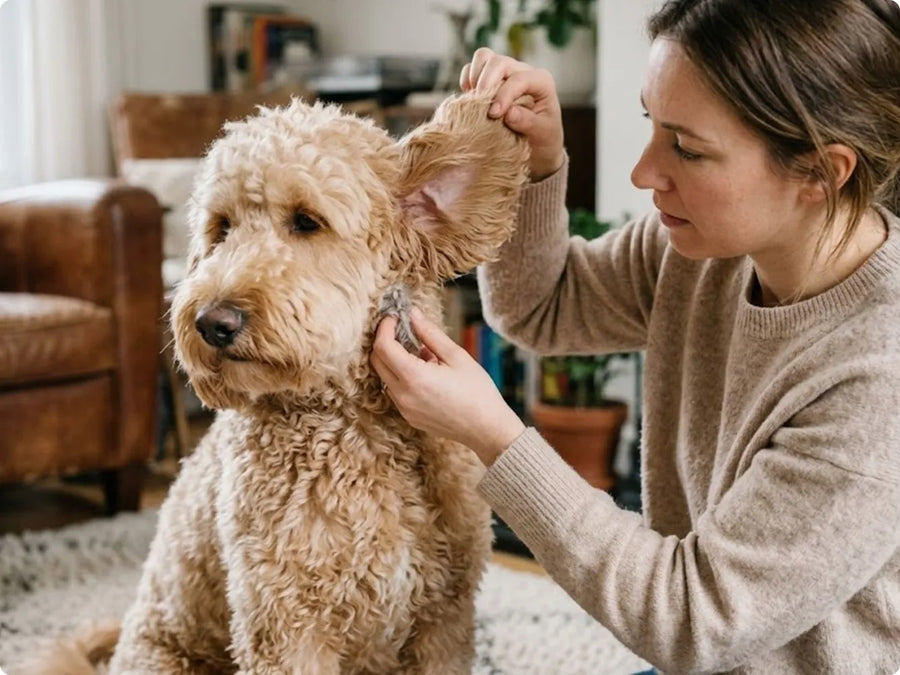
Why it mats first: the ears hang down and trap warmth and a little moisture, and there's constant friction from head-shaking, scratching, and collars turning against the coat. The coat here is fine and soft, which sounds easier to manage but actually tangles tighter and quicker.
What you'll feel: lift the ear and part the coat right at the base. An early tangle feels springy and snags your fingers slightly. A set mat feels firm and felted, and shifts against the skin as one solid piece.
The sign your dog gives: repeated head-shaking, scratching at one ear, or tilting away when you reach near the ear base.
-
The Armpits
Why it mats first: every single step compresses the coat in the armpit against itself. It's hidden under the leg, it's awkward to reach, and dogs naturally pull the leg back when you try to lift it — so it's one of the least-checked spots on the whole dog.
What you'll feel: gently lift the front leg and part the coat deep in the armpit. Early on you'll find a small knot you can still tease apart at the edges. A set mat is a tight band that tightens against the skin every time the leg moves.
The sign your dog gives: a slight stiffness on walks, reluctance to have a leg lifted, or flinching when touched in that area.
-
The Collar (or Harness) Line
Why it mats first: anything resting against the coat — a collar, a harness, even a bandana — rubs the fibres together until they weave into knots, usually in a band that mirrors exactly where the gear sits. It's especially common in dogs who wear a collar around the clock.
What you'll feel: slip the collar or harness off completely first, then run your fingers around the neck and chest. Early matting feels like roughness, with a few fibres starting to bind together. A set mat is a continuous band of dense coat right along the collar line.
The sign your dog gives: scratching at the neck, or a ring of coat that looks flatter and denser than the coat around it.
-
The Legs
Why it mats first: legs get dragged through everything — grass, mud, water, bedding, the floor. The coat there is usually longer and finer, so it tangles fast and dries slowly.
What you'll feel: part the coat in sections down each leg. Early tangles lift away from the surface easily. The ones to worry about sit close to the skin, and you can't part your fingers down through them.
The sign your dog gives: licking or chewing at the lower legs, or pulling away when you try to handle a paw or leg.
-
The Tail
Why it mats first: the tail drags through everything the legs do, the base is a compression zone from sitting and lying down, and the underside almost never gets looked at because it's out of sight.
What you'll feel: lift the tail and part the coat at the base and along the underside. Early on you'll find light tangling at the tips of each section. A set mat shows up as a dense, felted base that won't part down to skin.
The sign your dog gives: sitting or settling awkwardly, or sensitivity when you touch the base of the tail.
The comb test: your second opinion
Your hands and eyes find most of it. A finishing comb confirms the rest — but only after you've worked a section through with the brush, ideally a slicker brush for doodles. Pass the comb through and it should move without catching. Anywhere it stops, there's still a tangle the brush hasn't fully cleared, so you go back to the brush for that spot and test again.
One important note: the comb is a check, not a detangling tool. Don't drag it through a knot. It's there to tell you the work is done, not to do the work.
You've found one early — now what?
Caught small, most tangles come out gently at home. Reach for your softest tool first: a flexible-head slicker brush for doodles. The head is flexible, so it's better tolerated and reaches deeper into the undercoat where tangles actually hide, and the pins are super-rounded and highly polished, so there's no scratching against the skin. Work the edges of the tangle inward in small sections, and never force it.
For denser or thicker leg coats — or a dog who's sensitive about being brushed in the first place — the Extra Long Pin Slicker reaches further into the undercoat and clears more coat per stroke, so there's less brushing to get through. This dog brush makes each pass more efficient. Then confirm with the comb.
And the honest part: if a mat is sitting tight against the skin and you genuinely can't part down to skin through it, don't fight it. That one's a job for your groomer. Catching the other four early is exactly how you avoid the unwanted shave-down.
The takeaway
A Doodle that gets checked early rarely ends up matted. You don't need hours and you don't need a drawer full of tools — you need to know where to look and what you're feeling for. Spot it small, deal with it gently, and the grooming appointment becomes a tidy-up instead of a rescue mission.
🎁 The Doodle Brush System — our doodle brush trio — pairs the flexible slicker, the Extra Long Pin Slicker and the finishing comb — because one brush can't do four jobs.
Stay Connected with Us:
👉 Follow our Doodle Brush Facebook Page for expert grooming tips, tutorials, and updates.
👉 Join The Tangle-Free Doodle Club, our private Facebook group for Doodle parents — share grooming stories, get tips, and take part in giveaways!
Related Articles
📓The 5 Zones That Mat First on Almost Every Doodle
📓The 3 Stages of Matting (And How to Fix Each One)
📓How to Comb Doodle Hair: A Step-by-Step Guide
Q&A |
Do I really need both a slicker brush and a finishing comb?
|


