
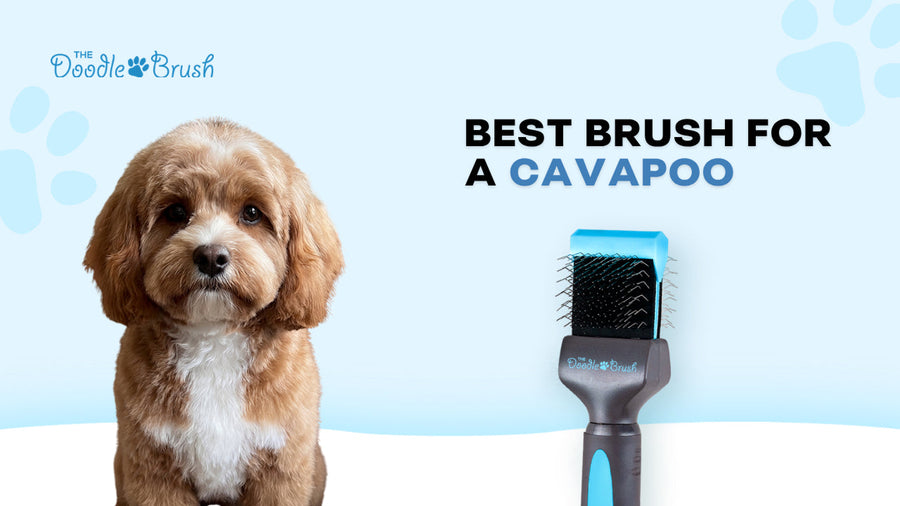

Cavapoos are the lapdogs of the Doodle world — small, soft, and usually attached to a human. That closeness is lovely, and it's also why the wrong brush shows up so fast with this breed: a Cavapoo that's had one bad brushing experience is a Cavapoo on the other side of the room every time the drawer opens.
Here's the brush that suits this coat, and how to use it so your Cavapoo stays on your lap for it.
What kind of coat does a Cavapoo have?
Like every Poodle cross, there's no single Cavapoo coat. The Cavalier side brings silky softness; the Poodle side brings curl and continuous growth. Most Cavapoos land somewhere between — a soft wave to a loose curl — and even littermates can differ, so you groom the coat in front of you, not the breed on the paperwork.
What most Cavapoo coats share is the Poodle-cross trait that defines the job: they're typically low-shedding, so loose hair doesn't fall to the floor. It stays trapped in that soft coat, twisting into tangles close to the skin — and soft, fine hair tangles tighter than coarse hair, which is why a Cavapoo's coat can go from silky to knotted faster than the coat's easy feel suggests.
Mats form everywhere on the body, just faster in the five high-risk zones: behind the ears, along the collar line, the legs, the tail, and the armpits. On a Cavapoo, the ears lead by a distance — the Cavalier drop ear plus fine hair plus limited airflow makes behind-the-ears the first place every groomer checks.
Do Cavapoos shed?
Very little, typically — and that's the catch. The hair a shedding breed leaves on your sofa, a Cavapoo keeps in its coat, where it becomes tangle material. Low-shedding means more brushing, not less; the brushing is how the loose hair finally leaves.
The best brush for a Cavapoo
Small dog, fine coat, sensitive temperament — the brush has to match all three.
The Single Head Flexible Slicker is the tool this breed was waiting for. The smaller head is scaled to a Cavapoo's frame — it works cleanly behind those ears, along the collar line, down small legs and into small armpits, where a full-sized brush overshoots or has to be held at an angle. The flexible head absorbs resistance when it meets a tangle instead of catching and dragging — on a fine coat over a small body, that difference is everything, because there's simply less dog between the brush and the skin. And the pins are super-rounded and highly polished: run the brush firmly across your own inner forearm, and it should feel like a firm massage. That's the standard your Cavapoo's skin should get too.
The Finishing Comb completes the pair. After brushing, glide it through each section to the skin. Where it moves freely, you're done; where it stops, there's a tangle left — back to the slicker, then check again. On a coat this soft, the comb matters even more than usual, because soft coats are the best in the business at looking brushed while holding a tangle underneath.
For Cavapoos whose adult coat comes in unusually thick or curly, the Extra Long Pin Slicker earns a place for the body coat — its longer pins reach through the extra depth and clear more per stroke. Most Cavapoos, though, are served for life by the Single Head and the comb.
How often should you brush a Cavapoo?
Little and often is made for this breed: five minutes a day, ears first, then the other four zones, comb check to finish. Wavier coats can settle at three to four sessions a week; curlier coats do best daily. During the puppy-to-adult coat change — usually somewhere between 6 and 12 months — daily is non-negotiable, because that's when the soft puppy hair loosens and the incoming adult coat traps it instantly.
The habit is easier to build with a Cavapoo than almost any breed, because the venue is wherever they already are: your lap, the sofa, the end of the evening. Brush where they're relaxed and the session becomes part of the cuddle, not an interruption to it.
What to avoid
Rigid fixed-head slickers punish fine coats — they catch on tangles and drag, and a small dog has nowhere to absorb that. Unpolished pin tips scratch soft skin under even light pressure. And surface tools — bristle brushes, grooming gloves — smooth the top of a Cavapoo coat beautifully while the tangles underneath keep tightening. If a brush has ever made your Cavapoo hide, it was almost certainly one of these — and it was the brush, not the dog, and not you.
The bottom line
The best brush for a Cavapoo is one scaled to the dog: the Single Head Flexible Slicker for the daily work, the Finishing Comb to prove the session reached the skin. Five gentle minutes a day, ears first — and the softest coat in the Doodle family stays exactly as soft as it looks.
Build your Doodle Brush Grooming System →
Stay Connected with Us:
👉 Follow our Doodle Brush Facebook Page for expert grooming tips, tutorials, and updates.
👉 Join The Tangle-Free Doodle Club, our private Facebook group for Doodle parents — share grooming stories, get tips, and take part in giveaways!
Related Articles:
📓 Do slicker brushes hurt dogs
📓 Best brush for doodle puppy
Q&A |
What is the best brush for a Cavapoo?A Single Head Flexible Slicker — sized for a small frame, with a flexible head that absorbs resistance and super-rounded polished pins for fine coats — paired with a Finishing Comb to confirm each session reached the skin. Do Cavapoos shed?Typically very little. Loose hair stays trapped in the soft coat rather than falling out, which is why regular brushing matters — trapped hair twists into tangles close to the skin. How often should I brush my Cavapoo?Five minutes daily for curlier coats, three to four times a week for wavier ones — always starting behind the ears, the breed's fastest-matting zone — and daily without exception during the 6–12 month coat change. Why does my Cavapoo hate being brushed?Usually a rigid or scratchy brush taught them to. Switch to a flexible head slicker with polished pins, keep sessions short and lap-based, and most Cavapoos relearn the brush quickly. |


