
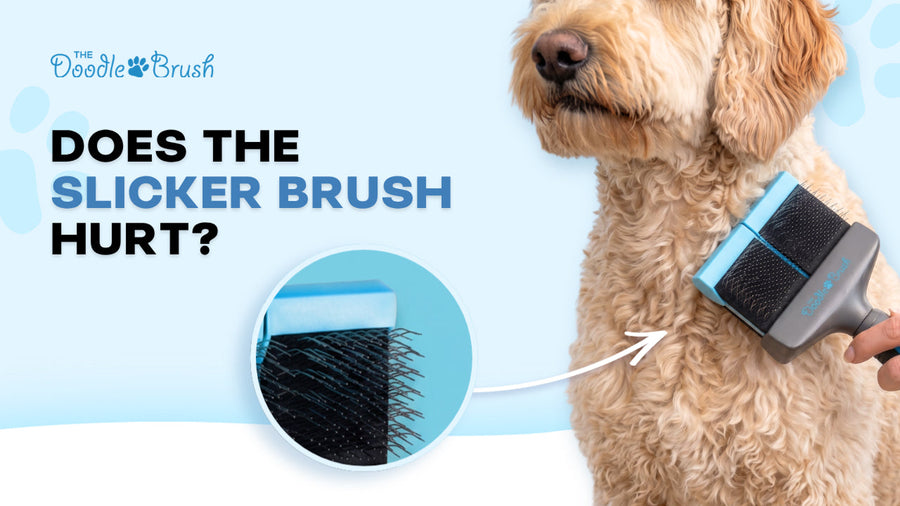

If you've watched your dog flinch, hide, or bolt at the sight of a slicker brush, this question isn't academic. So here's the direct answer:
A well-made slicker brush, used correctly, does not hurt a dog. But plenty of slickers aren't well made, and plenty are used incorrectly — and dogs remember. If your dog fears the brush, something specific caused it. Let's separate the real causes, because they get muddled together constantly and they need different fixes.
Cause one: the pins
On cheap slickers, the pin tips aren't properly rounded or polished. Under any pressure at all, those tips scratch the skin — invisible to you, entirely felt by your dog. A few sessions like that and the fear is installed.
What to look for instead: pins that are super-rounded and highly polished. Run a quality slicker firmly across your own inner forearm — it should feel like a firm massage, nothing more. That's the standard the skin-side of a brush should meet, every pin, every time.
Cause two: the head
This is the problem almost nobody names, and it's separate from the pins entirely.
Most slickers have a rigid, fixed head. When a rigid head meets a tangle, it can't give — so it catches and snags, wrenching the coat at the root. Your dog experiences a sudden yank with zero warning, over and over, at every knot. A slicker can have perfectly rounded pins and still deliver this experience, because the pins were never the issue — the head was.
What to look for instead: a flexible head. A flexible head does two things a rigid one can't:
-
It absorbs resistance. When it meets a tangle, the head flexes instead of catching — so there's no sudden snag, no yank. This is why flexible head slickers are so much better tolerated, and why for many dogs a brushing session genuinely feels like a massage.
-
It reaches deeper into the undercoat. Because it can work through the coat rather than skating across resistance, it gets down to the skin where trapped hair actually collects — which is the whole job.
To be precise about a detail that's often garbled online: it's the head that flexes, not the pins. The pins stay properly firm — that's what makes them effective — while the head absorbs the resistance.
Cause three: technique
Even a perfect brush hurts in the wrong hands. The three habits that cause it:
-
Pressing too hard. Let the brush do the work; the coat needs contact, not force.
-
Forcing through tangles. Meet resistance? Stop. Isolate the tangle with your fingers, hold the coat at its base to protect the skin, and work the edges gently.
-
Brushing only when there's a problem. If the brush only appears when the coat is already tangled, every session is a hard one. Five minutes daily on a tangle-free coat is the session your dog learns to enjoy.
"My dog already hates the brush — now what?"
Fear built by a bad brush can be unbuilt by a good one, but slowly:
-
Change the tool first. If the old slicker had unfinished pins or a rigid head, retire it — your dog's memory of it is accurate.
-
Reintroduce gradually. Brush in sight, treats, no contact. Then one gentle stroke on an easy area, treat, done. Extend over days, not minutes.
-
Start where dogs enjoy contact — the back and shoulders — before working toward the tricky spots like behind the ears and the armpits.
-
End every session early. Before your dog wants out, not after.
For dogs with denser, thicker coats, the Extra Long Pin Slicker is worth knowing about too — its longer pins reach through depth that defeats a standard slicker, and it suits brush-sensitive dogs who've struggled with tools that never quite worked. The gentlest tools in the system, though, are the flexible head slickers — that's exactly what the flexible head is for.
The bottom line
Slicker brushes don't hurt dogs. Scratchy unfinished pins hurt dogs. Rigid heads that catch and snag on tangles hurt dogs. Bad technique hurts dogs. Fix all three — super-rounded polished pins, a flexible head, and gentle little-and-often sessions — and brushing becomes something your dog queues up for. Ours do.
Build your Doodle Brush Grooming System →
Stay Connected with Us:
👉 Follow our Doodle Brush Facebook Page for expert grooming tips, tutorials, and updates.
👉 Join The Tangle-Free Doodle Club, our private Facebook group for Doodle parents — share grooming stories, get tips, and take part in giveaways!
Related Articles:
📓 What is a slicker brush used for?
📓 My Doodle hates being brushed - what to do?
📓 What to look for in a slicker brush for Doodles?
Q&A |
Do slicker brushes hurt dogs?Not when well made and used correctly. Discomfort comes from unfinished pin tips that scratch, rigid heads that catch and snag on tangles, or forcing the brush through knots. What is a flexible head slicker brush?A slicker whose head flexes as it works. It absorbs resistance instead of catching on tangles — so it's far better tolerated — and reaches deeper into the undercoat. Why does my dog hate being brushed?Usually a learned response to a scratchy or rigid brush, or to sessions that only happen once the coat is already tangled. Changing the tool and rebuilding the habit gradually resolves it for most dogs. Are the pins flexible on a flexible slicker?No — the head is flexible, not the pins. The pins stay firm and are super-rounded and polished; the head absorbs the resistance. |


