
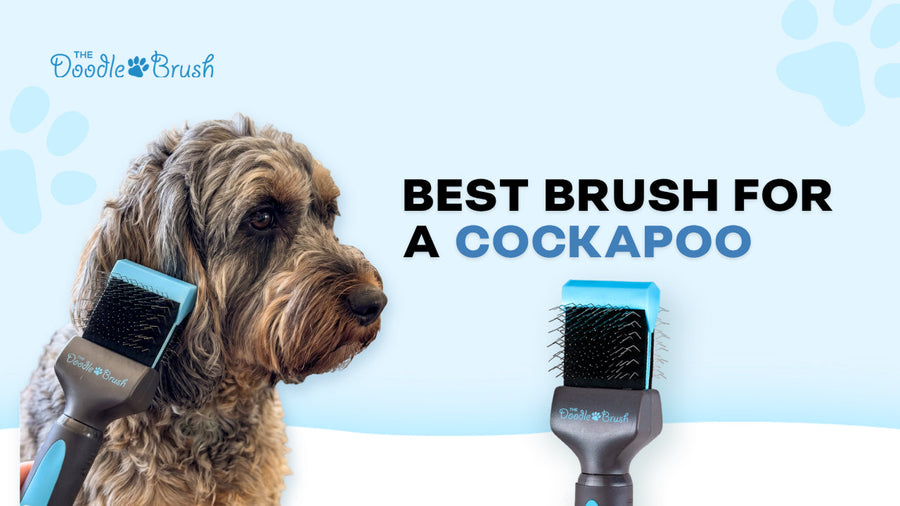

Ask a UK groomer what state most Cockapoos arrive in and you'll hear the same story: "brushed" on the surface, matted underneath. It's rarely the owner's effort that's missing — it's the brush.
Here's what groomers actually recommend for a Cockapoo coat, and why.
Why the Cockapoo coat catches owners out
Cockapoo coats vary dog to dog — curls, waves, or a straighter coat — so no single description covers the breed. But most share the Poodle-cross trait that defines the grooming job: they're typically low-shedding, so loose hair doesn't fall to the floor. It stays trapped in the coat, twisting into tangles close to the skin.
Mats form everywhere on a Cockapoo, just faster in the five high-risk zones: behind the ears, along the collar line, the legs, the tail, and the armpits. Cockapoo ears in particular are where groomers find the first mats — soft fine hair, constant movement, limited airflow under the drop ear.
The brush's job, then, is specific: reach through the coat to the skin, gently enough that your Cockapoo lets you do it every day.
Why most brushes fail — two separate problems
Problem one: the pins. On cheap slickers, the pin tips aren't rounded or polished, and they scratch the skin. A Cockapoo only needs a couple of scratchy sessions to decide the brush is the enemy.
Problem two: the head. Most slickers have a rigid, fixed head that catches and snags the moment it meets a tangle. Even flawless pins can't save a rigid head — every knot becomes a yank, and every yank teaches your dog to run.
Groomers see the result of both daily: dogs who panic at a slicker before it's touched them.
The best brush for a Cockapoo
For most Cockapoo coats, the recommendation is the Single Head Flexible Slicker — sized right for a Cockapoo's smaller frame and the intricate areas where their mats actually start.
What makes it work:
-
The flexible head absorbs resistance. It flexes when it meets a tangle instead of catching on it, so brushing is comfortably tolerated — for many dogs it feels closer to a massage than maintenance. That matters most on a breed this prone to brush-wariness.
-
It reaches deeper into the undercoat, where trapped hair collects and mats begin — not just across the surface where they're already visible.
-
Super-rounded, highly polished pins. Nothing scratchy ever touches the skin.
The compact single head also suits behind the ears, the armpits and the legs — the intricate areas where a bulkier brush simply can't work properly, and where a Cockapoo needs the most help.
How to brush a Cockapoo
-
Line brush. Part the coat to the skin with your free hand, brush the exposed layer outward, move the parting up, repeat in sections.
-
Five zones first. Behind the ears, collar line, legs, tail, armpits — every session, without exception.
-
Never force resistance. Isolate a tangle with your fingers, hold the coat at its base, work the edges gently.
-
Comb check to finish. Run a finishing comb through as the final check — glide means done, resistance means back to the brush. The comb checks; it never detangles.
For bathing, trimming, cuts and the full routine, our complete guide covers it all: Cockapoo Grooming: Cuts, Styles and How to Groom a Cockapoo at Home.
How often should I brush my Cockapoo?
Daily, in short sessions — around five minutes. Little and often keeps the coat tangle-free with almost no effort; a weekly marathon is always a struggle for you both. Every other day is the absolute minimum, with the five zones still checked whenever your Cockapoo has been wet or in a harness.
The payoff shows up at the groomer's: a tangle-free Cockapoo gets clipped with a guard to whichever style you've chosen. A matted one loses that choice — and avoiding unwanted shave-downs is precisely why the daily five minutes matter.
One brush can't do 4 jobs
The body coat, the tricky spots, the denser patches, and the finishing check are four different jobs — and one brush can't do 4 jobs. The Doodle Brush Grooming System pairs the Single Head with the right tool for each, designed around Poodle-cross coats from the start.
Build your Doodle Brush Grooming System →
Stay Connected with Us:
👉 Follow our Doodle Brush Facebook Page for expert grooming tips, tutorials, and updates.
👉 Join The Tangle-Free Doodle Club, our private Facebook group for Doodle parents — share grooming stories, get tips, and take part in giveaways!
Related Articles:
📓 Do slicker brushes hurt dogs
📓 The 5 zones that mat fastest on almost every doodle
Q&A |
What is the best brush for a Cockapoo?A flexible head slicker with super-rounded, polished pins — compact enough for a Cockapoo's frame and the intricate areas where mats start. The flexible head absorbs resistance instead of catching on tangles. How often should I brush my Cockapoo?Around five minutes daily, prioritising behind the ears, the collar line, legs, tail and armpits. Do Cockapoos need a slicker brush?Yes — but the right one: rigid-headed slickers with unfinished pins are why many Cockapoos fear brushing. Look for a flexible head and properly rounded pins. How do I brush a Cockapoo that hates being brushed?Short rewarded sessions, never forcing through resistance, and a brush with a flexible head — which is far better tolerated because it absorbs resistance rather than yanking at tangles. |


