
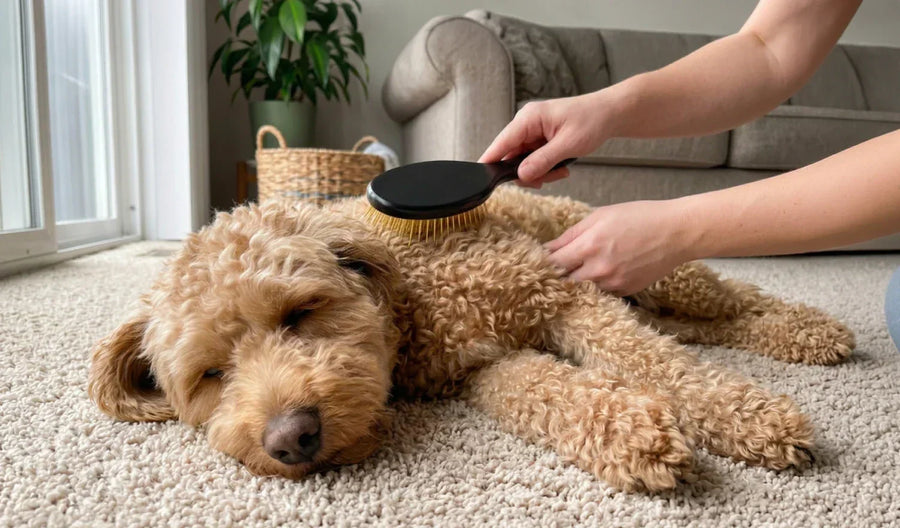

When it comes to grooming your Doodle, choosing the right tools is essential. For many owners, a pin brush for dogs is a staple of the grooming routine. But is it right for a Doodle's unique coat? In this guide, we'll explore what a pin brush does, when to use one, why it often falls short on Doodle coats — and what to use instead.
What Is a Pin Brush?
A pin brush is a grooming tool with long, widely spaced pins designed to pass through the outer layers of a dog's coat. It's commonly used for general brushing — lifting loose hair, dirt, and debris from the coat. The rounded pin tips are gentle on a dog's skin, which makes the pin brush a popular choice for many breeds.
What Does a Pin Brush Do for Dogs?
-
Removes loose hair and debris: the pins capture loose hair and any dirt or dust that has settled in the coat.
-
Handles light tangles: for dogs with looser, lighter tangles, a pin brush can help break them apart.
-
Supports skin health: brushing distributes the skin's natural oils, promoting a shinier, healthier-looking coat.
Pin brushes serve their purpose — but knowing when to use a pin brush matters. And for breeds like Doodles, the honest answer is: less often than you'd think.
Why a Standard Pin Brush Falls Short for Doodle Coats
Doodles — Labradoodles, Goldendoodles, Bernedoodles and every mix in between — have thick, curly or wavy coats that need more specialised care. While a pin brush can handle light surface brushing, it falls short where it matters most on a Doodle: reaching the undercoat, where mats actually form.
Limitations of pin brushes for Doodle coats:
-
Doesn't reach the undercoat: a standard pin brush simply doesn't have the structure to work down into the dense undercoat, which is where mats start.
-
Misses the tangles that matter: pin brushes work the outer layers of the coat — but on a Doodle, tangles form deep within the curls, close to the skin, where a pin brush never reaches them.
-
Struggles on thick coats: dense Doodle coats make it hard for widely spaced pins to work through without leaving the lower layers untouched — the coat looks brushed while mats keep building underneath.
The Solution: The Doodle Brush System — Designed for Doodle Coats
For Doodle coats, a standard pin brush on its own simply isn't enough. That's the real answer to the pin brush vs slicker question: effective Doodle grooming isn't about replacing one brush with another — it's about using the right tools together, each with a clear purpose.
Flexible Slicker Brushes — Everyday Control and Tolerance
The Single Head Flexible Slicker and Double Head Flexible Slicker form the backbone of regular coat maintenance.
Their flexible heads absorb resistance when they meet tangles, reducing snagging and sharp pulling compared to fixed-head brushes. This makes them far better tolerated by brush-sensitive Doodles and ideal for consistent, thorough brushing.
-
Double Head Flexible Slicker: ideal for full-body brushing and routine coat care. Its larger surface area covers more coat in fewer strokes, reducing brushing time without compromising results.
-
Single Head Flexible Slicker: best for precision work and the tighter zones — behind the ears, the collar line, and the armpits.
Together, these brushes keep the coat tangle-free between grooming appointments.
Extra Long Pin Slicker — Deep Detangling Where Mats Start
The Extra Long Pin Slicker is designed to reach deep into dense coats and the undercoat, where tangles begin. Its long, polished pins let you work through deeper problem areas efficiently, helping you stay ahead of mat build-up that would otherwise go unnoticed.
This tool is particularly valuable for:
-
Dense or curly coats
-
Undercoat tangles
-
Areas where mats seem to "re-appear" quickly
While highly effective, it works best alongside the flexible slickers for overall coat management.
Finishing Comb — The Truth Check
The Finishing Comb is the final step that confirms the job is done properly.
After brushing, the comb is used to check that every layer of the coat is truly tangle-free. If it glides through easily, you're done. If it catches, it highlights exactly where further brushing is needed.
This step is essential for preventing small, hidden tangles from tightening over time.
How to Groom Your Doodle with the Right Tools
An effective Doodle grooming routine uses each tool for what it does best:
-
Double Head Flexible Slicker — gently work through the main body, comfortably and efficiently. The wider head covers larger areas, so the body takes far less time while staying thorough.
-
Single Head Flexible Slicker — detangle delicate, hard-to-reach areas with precision: the face, legs, and the other tricky spots where tangles are more likely to form.
-
Extra Long Pin Slicker — tackle the dense undercoat and hidden tangles lurking beneath the surface, reaching where other brushes can't.
-
Finishing Comb — check for missed tangles and confirm a truly mat-free coat.
Stick to a regular schedule: brushing several times a week — or daily during coat changes — is far more effective than trying to fix problems once mats have tightened.
Final Thoughts: The Right Tool Makes All the Difference
A pin brush can play a role in light grooming, but Doodle coats demand more than a single tool. Think in terms of a complete routine: a system designed specifically for Doodle coats lets you catch tangles early, maintain a tangle-free coat, and significantly reduce the likelihood of unwanted shave-downs at the groomer.
🎁 Explore our best-selling Doodle Brush tools
Stay Connected with Us:
👉 Follow our Doodle Brush Facebook Page for expert grooming tips, tutorials, and updates.
👉 Join The Tangle-Free Doodle Club, our private Facebook group for Doodle parents — share grooming stories, get tips, and take part in monthly giveaways!
Related Articles
📓Single Head vs Double Head Slicker Brush for Doodles: What's the Difference?
📓What to Look for in a Slicker Brush for Doodles
📓The Complete Guide to Doodle Grooming Tools (And What You Actually Need)
Q&A |
What does a pin brush do for dogs?A pin brush lifts loose hair, dirt, and debris from the outer layers of the coat, handles light tangles, and helps distribute the skin's natural oils for a healthier-looking coat. It's a general-purpose surface brush — useful for many breeds, but limited on dense, curly coats where the real tangles form deeper down. When should I use a pin brush on my dog?For light surface brushing — a quick tidy-up, lifting debris after a walk, or general coat freshening on breeds with simpler coats. On a Doodle, it can play a small supporting role, but it should never be the main brush: it doesn't reach the undercoat, which is exactly where Doodle mats start. Pin brush vs slicker brush — what's the difference for a Doodle?A pin brush has long, widely spaced pins that work the outer coat. A slicker has densely packed pins that work through the full depth of the coat — and a flexible head slicker adds a head that absorbs resistance instead of dragging, making it far better tolerated on curly coats. For Doodles, the slicker does the real work; the comb confirms it's done; a pin brush is optional at best. Can a pin brush remove mats?No — and forcing one through a mat causes discomfort without clearing it. Mats sit close to the skin, below where a pin brush works. Deal with tangles using a flexible head slicker in short strokes from the edges inward, and if a mat is tight against the skin, leave it for your groomer. |


