
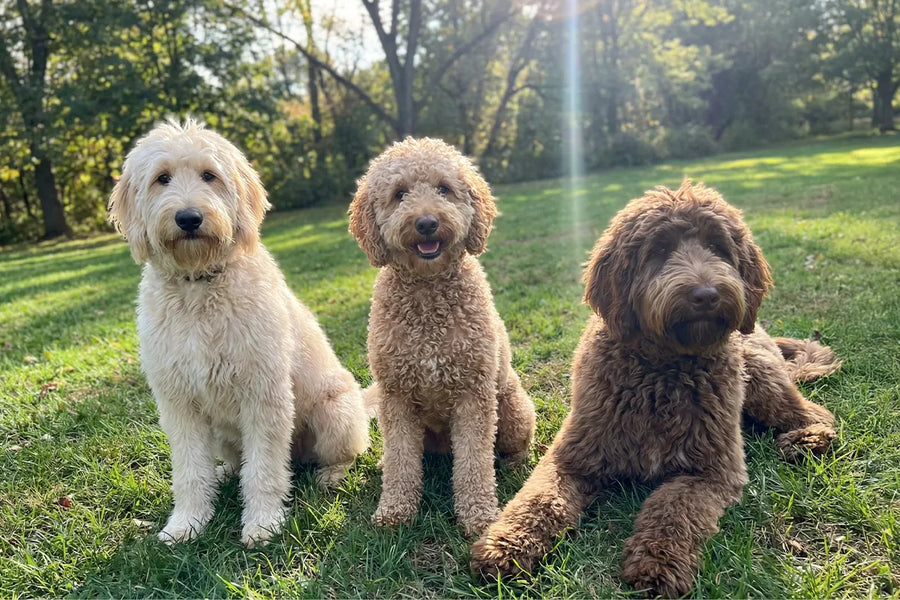

No two Doodles wear the same coat. Even within one litter, you can find straight, wavy, and curly coats side by side — and each one needs something different from you.
A Doodle's coat type determines almost everything about their grooming life: how often they need brushing, how quickly mats form, and how much work sits between grooming appointments. In this guide, we break down the three main Doodle coat types — straight, curly, and wavy — and what each means for maintenance and everyday care. For the full step-by-step method, see our guide to brushing a Doodle at home.
Straight Coat (Hairy) — The Lowest Maintenance
Some Doodles inherit a straighter, "hair-like" coat from their non-Poodle parent. It tends to be coarser to the touch, and it's the easiest of the three to keep tangle-free — though you'll notice more loose hair around the home than with curlier types.
What a straight coat means for you:
-
The lowest maintenance of the three coat types
-
Brushing 2–3 times per week is usually enough
-
Tangles and mats form far more slowly than in curly coats
Grooming tips:
-
Brush 2–3 times per week to keep the coat tidy and lift out loose hair
-
Finish each session with the Finishing Comb — if it glides through freely, you're done
-
Book grooming appointments as needed to keep the coat trimmed and neat
Curly Coat (Woolly) — The Teddy-Bear Look, the Highest Maintenance
The curly, woolly coat is the closest to the Poodle parent — dense, tightly curled, and the source of the classic teddy-bear look. It's also the most demanding coat of the three: loose and dead hairs don't fall away from tight curls, they get trapped and wrap into tangles, which is why curly coats mat fastest of all.
What a curly coat means for you:
-
The highest brushing commitment: daily is the goal
-
Mats form quickly — and invisibly, down at the skin — without consistent line brushing
-
The most frequent professional grooming schedule of the three types
Grooming tips:
-
Brush daily, using the line brushing technique — brushing from the skin out in layers (Part → Brush → Move Up) — so every session reaches the undercoat where tangles start
-
Check with the Finishing Comb after brushing; if it snags anywhere, go back to that spot with the slicker
-
Pay extra attention to the five zones that mat fastest: behind the ears, the collar line, the legs, the tail, and the armpits
-
A detangling spray makes brushing easier and more comfortable
-
Keep regular grooming appointments (roughly every 5–8 weeks)
👉 Shop tools made for curly coats in the Doodle Brush Collection.
Wavy Coat (Fleece) — The Balance
The wavy coat, sometimes called fleece, sits between the other two: silky soft, lovely to touch, and noticeably easier to manage than a curly coat — while still needing a real routine.
What a wavy coat means for you:
-
Moderate maintenance: consistent brushing, but not the daily commitment of a curly coat
-
Mats still form if the routine slips, especially in the high-risk zones
-
Regular trims keep the silky texture at its best
Grooming tips:
-
Brush 3–4 times per week, using the same line brushing technique to reach the skin
-
Finish with the Finishing Comb to confirm the coat is genuinely tangle-free
-
Use blunt-nosed scissors to keep the coat tidy around the eyes
-
A grooming appointment roughly every 8 weeks keeps the coat in ideal condition
Which Coat Does Your Doodle Have?
Coat type doesn't follow breed or size — a Goldendoodle can be curly and her littermate wavy. The simplest test is texture and pattern: tight, dense curls that hide the skin point to a curly coat; loose S-shaped waves to a wavy coat; and flat, coarser hair that parts easily to a straight coat. Many Doodles carry a combination, with curlier patches in some areas — in which case, groom to the curliest part of the coat.
Whatever coat your Doodle has, the principle is the same: consistency beats intensity. Short, regular sessions with the right tools will keep any of the three coat types healthy, comfortable, and tangle-free.
Which Brush for Which Coat Type?
Every tool in the Doodle Brush Grooming System was designed for these exact coats — here's how they map:
-
Straight coats: the Double-Head Flexible Slicker (or Single-Head for smaller dogs) makes quick work of the body; the Finishing Comb lifts out loose hair and confirms you're done.
-
Wavy coats: the same flexible head slickers, used with line brushing 3–4 times a week. The flexible head absorbs resistance instead of dragging, so sessions stay comfortable.
-
Curly coats: daily line brushing with a flexible head slicker — and for denser or longer adult coats, the Extra-Long Pin Slicker, whose longer pins reach the deeper layers where mats start. Always end with the Finishing Comb check.
Stay connected with us:
-
Follow our Doodle Brush Facebook Page for grooming tutorials and updates.
-
Join The Tangle-Free Doodle Club, our private Facebook Group for Doodle parents — share stories, get expert tips, and take part in monthly giveaways.
Related Articles
📓Which Doodle Is Right for Me?
📓How to Brush a Labradoodle: The Ultimate Guide
📓Complete Guide to Doodle Grooming Tools You Need
Q&A |
What are the key differences between straight, curly, and wavy Doodle coats?Straight coats are the lowest maintenance but shed more and can feel coarser. Curly (woolly) coats are low to non-shedding and give the “teddy bear” look, but they need the most grooming and are prone to matting without daily care. Wavy (fleece) coats strike a balance: silky, usually low to non-shedding, and moderate in maintenance. How often should I brush each coat type, and what technique should I use?Brush straight coats 2–3 times per week, wavy coats 3–4 times per week, and curly coats daily. Whatever the type, use the line brushing technique — part the coat to the skin, brush outward in short strokes, move up to the next line — then run the Finishing Comb through afterwards to catch anything the brush missed. How often should my Doodle see a professional groomer?Curly coats typically need a grooming appointment every 5–8 weeks, and wavy coats roughly every 8 weeks. Straight coats are more flexible — book trims as needed to keep the coat neat. Consistent brushing at home between appointments is what keeps every visit quick and stress-free. How do I know which coat type my Doodle has?Look at texture and pattern. Tight, dense curls that hide the skin mean a curly coat; loose waves mean a wavy coat; flat, coarser hair that parts easily means a straight coat. Many Doodles have a combination — groom to the curliest part of the coat, since that's where mats will form first. What basic grooming routine and tools do you recommend?Match the frequency to the coat type, brush from the skin out in layers, and confirm with the Finishing Comb after every session. A flexible head slicker suits all three coat types; curly or dense coats benefit from the Extra-Long Pin Slicker's deeper reach, and a detangling spray makes resistant coats easier to work through. For the full method, see our step-by-step brushing guide. |


