
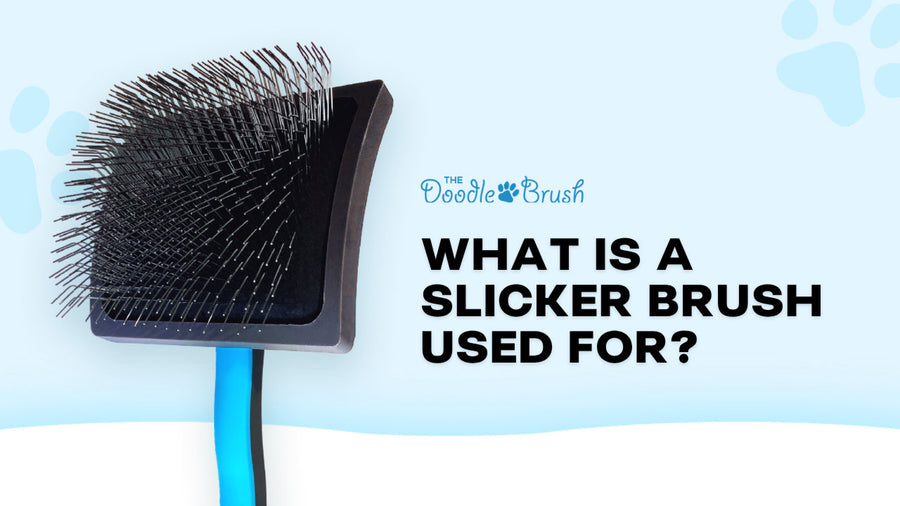

Walk into any pet shop and the slicker brush is the one you recognise without knowing its name: the flat, rectangular head packed with rows of fine wire pins. It's the most recommended dog brush in the world — and one of the least understood, which is why so many end up in a drawer under a lead and two poo-bag rolls.
Here's what a slicker brush actually is, what it's used for, which dogs need one, and when it's honestly the wrong tool.
What is a slicker brush?
A slicker brush is a grooming brush with a flat or slightly curved head filled with rows of fine, angled wire pins. The pin design is the whole idea: the fine pins pass through the coat rather than over it, and the slight angle lets them collect loose hair and work through tangles as the brush moves.
That through-the-coat action is what separates a slicker from every surface tool — bristle brushes, grooming gloves, rubber curries. Those smooth and polish the top of the coat. A slicker is built to reach the layers underneath, down toward the skin, where loose hair collects and tangles actually form.
What is a slicker brush used for?
Four jobs, in practice:
Removing loose hair. The angled pins collect dead, loose hair from all through the coat — including the hair that low-shedding coats trap instead of dropping. On a Doodle, a Poodle, a Bichon or any curly cross, the slicker is how that trapped hair finally leaves the dog.
Detangling. Go section by section with short strokes, and the pins catch tangles early — before they pack down into mats. This is the slicker's most important job on curly and long coats — and the reason it's the daily tool rather than an occasional one.
Reaching the undercoat. Mats don't form on the surface; they form close to the skin. Given enough pin length, a slicker reaches that layer — which is exactly what surface brushes can't do, and why a coat that's only ever surface-brushed can look perfect while matting underneath.
Skin and coat health. Brushing through to the skin distributes natural oils, lifts out debris, and — done with the right brush — gets the skin air it doesn't get under a packed coat.
Which dogs need a slicker brush?
Any dog whose coat tangles: curly coats (Poodles and every Doodle cross), long and silky coats, wavy coats, dense double coats. The tighter the curl and the longer the coat, the more the slicker shifts from "useful" to "essential" — a curly coat left without one doesn't stay fluffy, it quietly felts.
Where a slicker earns less of its keep: genuinely short, smooth coats — a Beagle or a Boxer sheds onto the floor rather than into a coat, and a rubber curry or bristle brush does that job comfortably.
Flexible vs firm: the difference that decides everything
Not all slickers are the same tool, and the difference isn't the pins — it's the head.
A standard slicker has a rigid, fixed head. When it meets resistance — a tangle, a dense patch, the curve of a rib — it has nowhere to go. It catches and drags on the tangle, and on a curved body it presses hard at the centre of the stroke while lifting off at the edges. This is the brush most owners have already tried, and the reason "my dog hates the brush" is one of the most common sentences groomers hear.
A flexible head slicker moves at the head. When it meets a tangle, the head gives — it absorbs the resistance instead of forcing through it, letting the pins work into the tangle gradually. Across the curves of a dog's body, the head keeps the pins in even contact instead of digging at the high points. The result is a brush that reaches deeper and is far better tolerated — which matters, because the best brush is the one your dog lets you use every day.
One thing to be clear on, because the marketing around cheap brushes muddles it: it's the head that should flex, never the pins. The pins stay firm — that's what gets them through the coat — with super-rounded, highly polished tips so they glide against skin rather than scratch. Bending pins are a red flag, not a feature. (If your question is specifically whether slickers hurt — they shouldn't, and our guide to slicker brushes and comfort covers exactly what goes wrong when they do.)
How to use a slicker brush properly
The tool is half the job; the method is the other half:
-
Work in sections, not sweeps — part the coat so you can see skin, and brush outward from the skin in short strokes.
-
Let the brush do the pressure. You guide; the pins work. If you're pressing hard, something's wrong with the brush or the tangle needs a gentler approach from its edges.
-
Prioritise the five high-risk zones where mats form fastest: behind the ears, along the collar line, the legs, the tail, and the armpits.
-
Finish with a comb check. A finishing comb run through each section tells the truth: gliding means done, snagging means back to the slicker. The comb is only ever the check — never the detangling tool.
-
Little and often. Five minutes several times a week beats a monthly marathon, for the coat and for the dog's patience.
When a slicker is the wrong tool
Honesty corner: a slicker is not a dematting tool for set mats. A mat that's tightened into felt against the skin shouldn't be fought with any brush — that's a job for a professional groomer, and forcing a slicker through it is how dogs learn to fear brushing. The slicker's power is prevention: used regularly, it's the reason mats never get that far.
The bottom line
A slicker brush is the through-the-coat tool: it removes trapped loose hair, separates tangles before they become mats, and reaches the undercoat where the trouble actually starts. On curly and long coats it's not optional — and the version worth owning has a flexible head that absorbs resistance and firm, super-rounded, polished pins that pass the forearm test. The Double Head Flexible Slicker is ours; the full System adds the precision, depth and checking tools around it — because brushing the body, working the tricky spots, handling dense coats and confirming the finish are different jobs, and one brush can't do 4 jobs.
Build your Doodle Brush Grooming System →
Stay Connected with Us:
👉 Follow our Doodle Brush Facebook Page for expert grooming tips, tutorials, and updates.
👉 Join The Tangle-Free Doodle Club, our private Facebook group for Doodle parents — share grooming stories, get tips, and take part in giveaways!
Related Articles:
📓 What to look for in a slicker brush for Doodles
📓 Do slicker brushes hurt dogs?
📓 Single Head vs Double Head slicker brush for Doodles
Q&A |
What is a slicker brush used for?Removing loose hair from all through the coat, separating tangles before they become mats, reaching the undercoat where mats form, and supporting skin health by distributing natural oils. It's the primary daily tool for curly, wavy, long and dense coats. What's the difference between a slicker brush and a normal brush?A slicker's fine, angled wire pins pass through the coat to the layers near the skin. Bristle brushes, gloves and curries are surface tools — they smooth the top of the coat but can't reach where loose hair collects and tangles form. What is a flexible head slicker brush?A slicker whose head flexes as it works, absorbing resistance instead of catching and dragging on tangles, and keeping the pins in even contact across the body's curves. The pins themselves stay firm, with super-rounded polished tips — it's the head that flexes, never the pins. Can a slicker brush remove mats?It prevents them and can gently work early tangles from their edges. A set, felt-like mat against the skin is a professional groomer's job — no brush should be forced through one. |


