
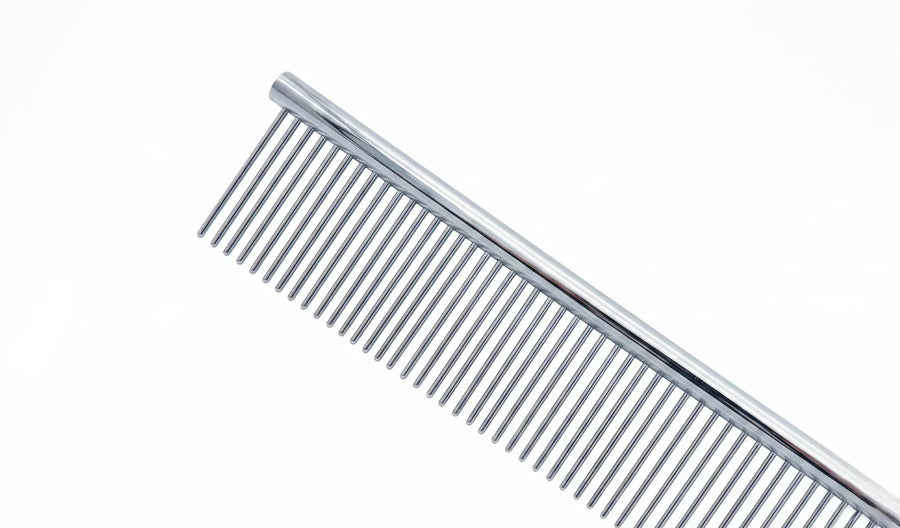

If you asked us a few years ago what a finishing comb was for, we probably couldn't have given you a proper answer. We'd brushed our Doodle. We thought we were done. That's how most people think about grooming at home — brush the coat, done, move on.
Then we kept having the same conversation with our groomer. "There were a few mats underneath. Just small ones. We worked them out." And we kept thinking: how did we miss them? We'd brushed. We'd been thorough. So what were we missing?
It turned out we were missing the step that tells you whether the brushing actually worked.
What a finishing comb is actually for
A finishing comb is a straight-toothed comb with teeth spaced closely enough to pass through a tangle-free coat smoothly — but close enough to catch anything the brush left behind. It looks simple, and it is. But its job is specific, and it's different from every other tool in the grooming routine.
It's not a detangling tool. It's not something you use on a matted coat. You don't start a grooming session with the finishing comb — you end one with it.
The finishing comb is the check.
How we use it (and when)
The way we use our Finishing Comb is always the same. Once we've brushed the coat properly — tricky spots first with the Single Head Flexible Slicker, then the main body with the Double Head Flexible Slicker, and the deeper reach on thicker areas with the Extra Long Pin Slicker — we reach for the Finishing Comb last.
And then we just run it through the coat, section by section.
If it glides, we're done.
If it catches, we know exactly where a tangle is hiding.
That's the whole mechanic. It's binary. There's no guessing, no "I think I got it all, I hope so." The comb either glides or it catches. And if it catches, you go back with the slicker to that specific spot, work the tangle out, and check again.
We find tangles we'd have completely missed otherwise — almost always close to the skin, almost always in the tricky spots (armpits, collar, behind the ears, legs, tail). The slicker works them out. The comb keeps us honest about it.
Why this matters for Doodle coats specifically
This is where it all connects back to how Doodle coats behave.
Doodle coats are curly, dense, and low-shedding. Dead hair doesn't fall away — it stays held in the curl, tangles with the living hair around it, and compresses close to the skin. Out of sight.
Which means a Doodle coat can look perfectly fine on the surface and still have tangles forming underneath. You can brush for fifteen minutes, feel confident you've done a thorough job, and miss them entirely — because the surface of the coat and the layer closest to the skin aren't showing you the same thing.
The finishing comb is the only way to actually confirm what you can't see.
Without it, you're brushing on trust. With it, you're brushing on evidence.
What a finishing comb is not
This is worth being clear about, because it's where a lot of owners go wrong:
A finishing comb is not for detangling. If you hit a mat with it, don't try to force it through. That's painful for the dog, it damages the comb, and it doesn't work. Go back to the slicker. The finishing comb's job is to find the tangle, not to fix it.
It's not a replacement for brushing. Running a comb through an unbrushed Doodle coat will be frustrating and uncomfortable for both of you. The comb only works after the brushing has been done properly.
It doesn't replace the groomer. It makes you a better partner to your groomer — not a substitute for one. Your groomer sees the deeper maintenance work and the scissor finishing that keeps the coat healthy over time. The finishing comb helps you make sure what you send them is tangle-free.
Why we made it part of the system
When we designed the Doodle Brush Grooming System, the finishing comb wasn't an afterthought. It's the step that changed how we brushed — because it was the first time we actually knew, session by session, whether we'd done the job properly.
Before the comb, "done" was a guess. After the comb, "done" is something you can feel. The comb glides through every section of the coat. That's what done feels like.
Most Doodle owners we talk to don't own a finishing comb. Most own multiple brushes. And the same theme keeps coming up — mats found at the groomer, sessions that felt thorough but weren't, a coat that looks fine on the surface and isn't underneath.
The finishing comb is the tool that closes that gap.
If you've been through the wrong-brush cycle and you're still finding surprise mats at the groomer, this is the missing piece.
🎁 Explore our best-selling Doodle Brush tools
Stay Connected with Us:
👉 Follow our Doodle Brush Facebook Page for expert grooming tips, tutorials, and updates.
👉 Join The Tangle-Free Doodle Club, our private Facebook group for Doodle parents — share grooming stories, get tips, and take part in monthly giveaways!


