
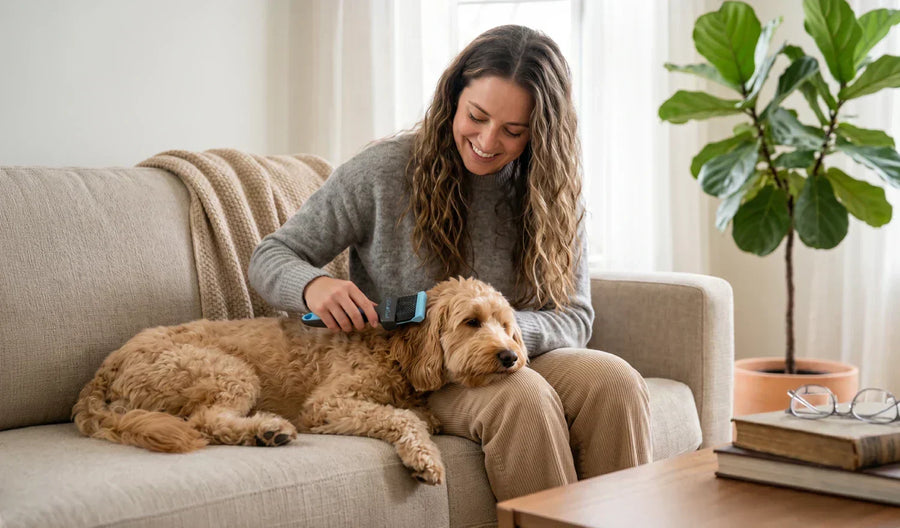

Brushing doesn't have to be a battle. But for a lot of Doodle owners, that's exactly what it becomes.
A dog scared of the brush sees it and disappears. Or they stay, but they're tense the whole way through, shifting around, turning to look at what you're doing, waiting for it to be over. The session ends with both of you frazzled, and the whole thing gets put off a little longer next time.
Here's what's worth understanding: a Doodle that resists brushing isn't being difficult. They're responding to an experience that hasn't felt good enough, consistently enough, to be something they're willing to settle into. That's not a character flaw. It's information. And it's entirely fixable. If you're wondering how to get my dog to like being brushed — or at least tolerate it calmly — this is where to start.
Making brushing a positive experience isn't about tricks or treats alone. It's about changing what the session actually feels like, from start to finish, until the brush stops predicting something unpleasant and starts predicting something calm and familiar instead.
Why Some Doodles Learn to Hate Brushing
Before looking at how to change things, it helps to understand how a dog ends up brush-averse in the first place.
The most common reason is discomfort. A single session that involved pulling, snagging, or pressure in a sensitive area can be enough to create a lasting negative association. Dogs have excellent associative memory for uncomfortable experiences, and a Doodle that had a bad brushing experience months ago may still be reacting to that memory today. Every time the brush comes out, the memory comes with it.
The second most common reason is duration. If sessions regularly run long because the coat isn't being cleared efficiently, the dog learns to anticipate a drawn-out, tiring experience. They start finding ways to opt out before the brush is even in your hand.
The third reason is inconsistency. A dog that's brushed infrequently never gets the chance to build tolerance or familiarity. Each session feels like a new and uncertain event rather than a known, predictable routine. Uncertainty in dogs tends to produce avoidance.
All three of these have the same fix at their core: make the experience genuinely better, and repeat it often enough that the new association replaces the old one.
Start Before You Even Pick Up a Brush
The most important part of rebuilding a positive brushing experience happens before any tools come out.
If your Doodle already has a negative association with the brush, reintroducing it gradually is far more effective than pushing through the resistance. Place the brush on the floor near your dog without attempting to use it. Let them sniff it, investigate it, and be around it without anything happening. Do this over several short sessions.
Once your dog is comfortable with the brush being present, hold it near them, still without brushing. Pair its presence with something they enjoy: a calm voice, a treat, a relaxed moment together. You're changing what the brush predicts before you've brushed a single stroke.
This process feels slow, particularly if you're also managing a coat that needs regular attention. But a dog that approaches the brush with curiosity instead of avoidance will always be easier and faster to groom than one that needs to be caught, held, and managed through a session they're trying to escape.
Get the Environment Right
Where and how you groom makes more difference than most owners expect.
A stable, consistent grooming space helps your dog know what to expect. Whether that's a grooming table or a non-slip mat on a firm surface, the physical setup should feel secure. A dog that's shifting around trying to find their footing is a dog that's already uncomfortable before a brush has touched their coat.
The time of day matters too. Brushing a dog that's just come in from a high-energy walk, or that's overdue a meal, is working against yourself. A dog that's calm, settled, and not anticipating something else is far more receptive. Some owners find that brushing after a calm period of rest produces consistently better sessions.
Your own energy matters most of all. If you approach the session tense, rushed, or braced for a battle, your dog will feel it. Doodles are perceptive about the emotional state of the people around them, and a handler who is calm and unhurried signals safety in a way that no treat alone can replicate. Take a breath before you start. Settle yourself first.
Keep Sessions Short
This is the single most effective change most owners can make, and it's the one most often resisted because it feels counterintuitive.
If brushing sessions are currently long and difficult, the instinct is often to push through until the coat is done. The problem is that every difficult session reinforces the negative association. Your dog's experience of brushing is long, uncomfortable, and unavoidable. That's the association being strengthened with each session you push through.
Short sessions change that. Five to ten minutes, done calmly and stopped before the dog's tolerance runs out, builds a completely different association over time. The dog learns that brushing ends while they're still comfortable. That predictability is reassuring. And a dog that isn't braced against what's coming is a dog you can actually groom properly.
Once short sessions are going well and your dog is relaxed throughout, you can gradually extend them. Tolerance builds through positive repetition, not through endurance. The goal is to stop while things are still good, every time, until the window of calm extends naturally.
Use the Right Tools
A dog that has been brushed with a tool that pulls, snags, or concentrates pressure uncomfortably on sensitive skin will have learned to associate that feeling with all brushing. Switching to the right tool is often the fastest way to break that association.
A flexible head slicker handles resistance completely differently to a rigid brush. The head absorbs resistance as it moves across the coat, rather than dragging on tangles and concentrating pressure at contact points. In the five hotspot zones — behind the ears, the collar line, the legs, the tail, and the armpits — where skin is thinner and sensitivity is higher, this difference is particularly significant. A dog that flinches with a rigid brush will very often tolerate a flexible head brush in the same area without reacting.
The Doodle Brush Double Head Flexible Slicker is specifically designed for this. Its flexible head absorbs the resistance and reaches deeper into the undercoat, making consistent, even contact without the pulling that causes dogs to tense and pull away. For brush-sensitive Doodles in particular, this is usually the tool that changes how sessions feel.
For the tighter hotspot zones, the Single Head Flexible Slicker gives you the same flexible head technology in a smaller format, with the precision to work carefully behind the ears, deep into the armpits, along the collar line, down the legs, and at the base of the tail without forcing a larger brush head into areas it doesn't suit.
The right tool doesn't just make grooming more effective. It makes it more comfortable, and that's what changes the experience your dog has of being brushed.
Work With Your Dog, Not Against Them
During the session itself, your dog's body language is giving you constant information. Learning to read it means you can respond to what's happening rather than pushing through resistance that's telling you something important.
A relaxed dog stays relatively still, keeps their muscles loose, and doesn't pull away from the brush.
Slight tension, turning to look at what you're doing, muscle stiffening, or repeated attempts to shift position are all signals worth responding to. Your dog's communication matters; responding to it rather than overriding it builds trust, and trust is what makes a dog willing to stay still for a grooming session rather than looking for a way out of it.
Pair the session with calm, low-key praise throughout. Not excited or high-pitched, which can tip a dog into stimulation rather than calm, but quiet, steady reassurance that tells them they're doing well and the experience is safe.
Always End on a Positive Note
This step is more important than it might seem.
Whatever happens during the session, end it before your dog's patience runs out, and end it with something good. A few minutes of calm stroking, a treat, or simply a quiet moment together before your dog gets off the table. The last thing your dog experiences during a grooming session is what they'll carry into the next one.
A session that ends with your dog still comfortable, still trusting, and still calm will always produce a better association than one pushed to its limit that ends in relief on both sides.
Over time, consistent positive endings change the entire frame of what brushing means to your dog. It stops being something to escape and starts being something familiar and safe.
That shift doesn't happen after one session. It happens after many, each one a little better than the last. But it does happen, and it makes every session that follows easier.
Build a Routine and Stick to It
Consistency is what cements the change.
A dog that's brushed regularly, in the same space, in the same order, with the same calm energy, builds familiarity with the whole experience. Familiarity reduces anxiety. A routine that's repeated often enough stops being something a dog needs to brace against and becomes something they simply move through.
This is also practical from a coat perspective. Regular short sessions keep the five hotspot zones — behind the ears, the collar line, the legs, the tail, and the armpits — clear before tangles have a chance to tighten. A coat that's maintained consistently is far easier and more comfortable to brush, which in turn means sessions stay shorter and calmer, which further reinforces the positive association.
The routine and the coat condition support each other. Regular brushing produces a clearer coat. A clearer coat produces easier sessions. Easier sessions produce a more tolerant dog. And a more tolerant dog makes the routine something you actually look forward to rather than something you put off.
Final Thoughts
A Doodle that hates brushing isn't a lost cause. They're a dog whose experience of brushing hasn't been good enough to make it something they're willing to accept.
The fix is consistent: shorter sessions, the right tools, the right environment, and an approach that works with your dog's responses rather than pushing through them. Change what brushing predicts, repeat it until the new association is stronger than the old one, and the battle gradually fades.
Start where you are. Keep sessions short. Use a brush that doesn't drag on mats and tangles uncomfortably. Pay attention to your dog's body language. End every session while things are still calm. And be consistent, because consistency is what actually changes things over time.
Brushing doesn't have to be a battle. With the right approach, it can become one of the quieter, calmer parts of your routine together.
👉 Shop The Doodle Brush Double Head Flexible Slicker for brush-sensitive doodles who need a gentler, more comfortable experience and one of the best brush for doodles options available.
👉 Shop The Doodle Brush Single Head Flexible Slicker for precision work in sensitive hotspot zones and as a reliable dog doodle brush.
🎁 Explore The Doodle Brush Grooming System for everything you need to build a grooming routine your doodle will actually tolerate—the best doodle brush setup many owners rely on.
Stay Connected with Us:
👉 Follow our Doodle Brush Facebook Page for expert grooming tips, tutorials, and updates.
👉 Join The Tangle-Free Doodle Club, our private Facebook group for doodle parents. Share grooming stories, get tips, and take part in monthly giveaways.
Related Articles
📓Why Does My Doodle Run Away From the Brush?
📓My Doodle Hates Being Brushed — What to Do
📓How to Get a Doodle Puppy Used to Being Brushed
Q&A |
How do I get my dog to like being brushed?Change what brushing predicts. Reintroduce the brush gradually with no brushing at first, keep sessions to 5–10 calm minutes that end before tolerance runs out, switch to a flexible head slicker that absorbs resistance instead of dragging, and end every session on a positive note. Repeat consistently, and the brush stops predicting something unpleasant and starts predicting something calm and familiar. Why do some Doodles learn to hate brushing, and is it fixable?Most brush aversion comes from three sources: discomfort (pulling, snagging, or pressure that felt bad once and left a lasting memory), duration (sessions that run too long and feel exhausting), and inconsistency (infrequent brushing that never becomes familiar). All three respond to the same solution: make the experience genuinely more comfortable, keep sessions short enough to end while your dog is still relaxed, and repeat that positive pattern consistently. Yes — this is fixable. How do I reintroduce the brush to a dog scared of the brush?Start before you brush. Place the brush on the floor near your dog and let them investigate without using it. In later short sessions, hold the brush near them and pair its presence with calm praise or a treat — still no brushing. You're changing what the brush predicts from "something unpleasant" to "something calm and familiar." Only after your dog is relaxed around the brush do you begin gentle strokes. How long should brushing sessions be, and how do I build tolerance?Aim for 5–10 minutes, done calmly, and stop before your dog's tolerance runs out. Ending while they're still comfortable teaches predictability and safety. As your dog stays relaxed through these short sessions, extend them gradually. Tolerance grows through positive repetition — not by pushing through difficult, drawn-out grooming. Always finish on a positive note so your dog carries that feeling into the next session. Which tools make brushing more comfortable, especially in sensitive areas?Switch to a flexible head slicker. Unlike rigid brushes, the flexible head absorbs resistance instead of concentrating pressure — especially important in the five hotspot zones: behind the ears, the collar line, the legs, the tail, and the armpits. The Double Head Flexible Slicker gives gentle, even contact across the body, while the Single Head Flexible Slicker provides precision in the tighter, more sensitive zones. For stubborn tangles, work gently with the slicker from the edges of the tangle inward, supporting the coat at the base with your free hand to protect the skin. What setup and handling choices make the biggest day-to-day difference?Create a stable, consistent grooming space (grooming table or non-slip mat) so your dog feels secure. Choose a calm time of day — not right after high-energy activity or when your dog is hungry. Your own calm, unhurried energy is crucial; Doodles read your tension. During brushing, watch body language: relaxed muscles and stillness are green lights; stiffness, turning to look, or shifting away mean it's time to slow down, adjust, or pause. Use quiet, low-key praise, and always end while things are still calm. Build a routine — same space, same order, same energy — so frequent short sessions keep the hotspot zones clear and make every future session easier. |


