
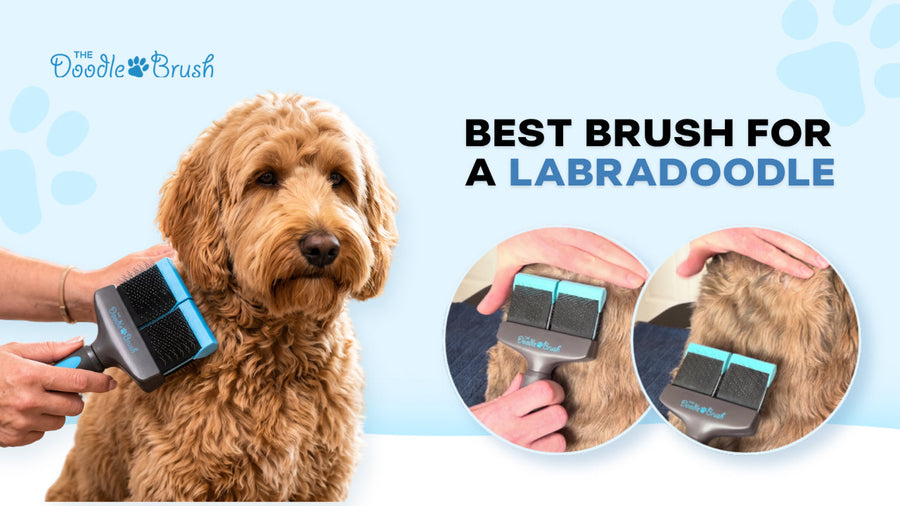

Ask ten Labradoodle owners which brush they use and you'll get ten different answers — usually followed by "…but it doesn't really get through the coat." That's not bad luck. Most brushes on the market were designed for shedding breeds, and a Labradoodle is a different animal entirely.
Here's what actually works, why, and how to use it.
What kind of coat does a Labradoodle have?
There's no single "Labradoodle coat." Because they're a Poodle cross, coats vary from dog to dog — some are tightly curled like their Poodle parent, some are soft and wavy, some are closer to a straighter hair coat. Even two dogs from the same litter can be completely different.
What most Labradoodle coats share is this: dense growth that traps loose hair and debris close to the skin, where it twists into tangles. Left alone, those tangles become mats — and mats form everywhere on the body, just faster in the five high-risk zones: behind the ears, along the collar line, the legs, the tail, and the armpits.
So the right brush isn't about breed. It's about whether the tool can reach through that density to the skin without a fight.
Do Labradoodles shed?
The question everyone googles — and the answer needs a bit of nuance.
Labradoodles are typically low-shedding. But low-shedding doesn't mean the hair stops falling out. It means that when hair is released, it doesn't drop to your floor — it stays trapped inside the coat, woven around the hair that's still growing.
That trapped hair is exactly what mats are made of. So the "non-shedding" coat that made you fall in love with the breed is the same reason brushing matters more for a Labradoodle than for almost any other dog. The hair your sofa never sees has to come out through the brush instead.
Why most slicker brushes struggle on a Labradoodle
Two separate problems, and it's worth keeping them separate:
1. The pins. On cheap slickers, the pin tips aren't properly rounded or polished. Those tips scratch the skin, and your dog learns — very quickly — that the brush means discomfort.
2. The head. Most slickers have a rigid, fixed head. When a fixed head meets a tangle, it catches and snags on it, yanking at the coat. Even with perfect pins, a rigid head turns every knot into a tug-of-war.
Either one is enough to create a dog that hides when the brush comes out.
The best brush for a Labradoodle
For most Labradoodle coats, we recommend the Double Head Flexible Slicker. Two things make the difference:
-
The flexible head absorbs resistance. Instead of catching and yanking when it meets a tangle, the head flexes — so brushing is far better tolerated, and for many dogs it feels closer to a massage than a chore.
-
It reaches deeper into the undercoat. Density is the whole challenge with a Labradoodle coat, and a flexible head works down to the skin where trapped hair actually collects — not just across the surface.
The pins themselves are super-rounded and highly polished, so there's nothing sharp meeting the skin. Flexible head, comfortable pins — both problems solved, separately and properly.
How to brush a Labradoodle
A brush is only half the job. Technique is the other half:
-
Work in sections. Part the coat with your free hand and brush in layers, from the skin outward — never just over the top. Surface brushing is how "brushed" dogs still arrive matted at the groomer.
-
Start with the five high-risk zones. Behind the ears, collar line, legs, tail, armpits. If you only have five minutes, spend them there.
-
Keep sessions short and frequent. Five minutes a day beats an hour on Sunday. Little and often keeps the coat tangle-free and keeps brushing a pleasant habit rather than a battle.
-
Finish with a comb check. Once brushing is done, run a finishing comb through the coat as a final check. If it glides through, you're genuinely done. If it meets resistance, go back to the brush in that spot. (The comb is a check, never a detangling tool.)
Labradoodle grooming beyond the brush
Home brushing doesn't replace the groomer — it protects what happens there. A Labradoodle that arrives tangle-free gets the trim you actually asked for, clipped with a guard to the length you like. A matted coat takes that choice away, and that's how owners end up with unwanted shave-downs they never planned.
Regular grooming appointments every 6–8 weeks, daily or near-daily brushing at home, and a comb check to confirm the work — that's the whole routine.
One brush can't do four jobs
Brushing the body, reaching intricate areas, working through denser patches, and checking the finish are four different jobs — and one brush can't do 4 jobs. That's why the Doodle Brush Grooming System exists: the right tool for each part of the coat, designed around Doodle coats specifically.
Build your Doodle Brush Grooming System →
Stay Connected with Us:
👉 Follow our Doodle Brush Facebook Page for expert grooming tips, tutorials, and updates.
👉 Join The Tangle-Free Doodle Club, our private Facebook group for Doodle parents — share grooming stories, get tips, and take part in giveaways!
Related Articles:
📓 The 5 zones that mat fastest on almost every doodle
Q&A |
What is the best brush for a Labradoodle?A flexible head slicker with super-rounded, polished pins. The flexible head absorbs resistance instead of catching on tangles, and reaches deeper into the undercoat where trapped hair collects. Do Labradoodles shed?Labradoodles are typically low-shedding. Loose hair doesn't fall to the floor — it stays trapped in the coat, which is why regular brushing is essential to prevent mats. How often should I brush my Labradoodle?Little and often: around five minutes a day, focusing on behind the ears, the collar line, legs, tail and armpits. Can I use a finishing comb to detangle my Labradoodle?No — the finishing comb is a post-brushing check only. Brush first, then use the comb to confirm the coat is tangle-free. |


