
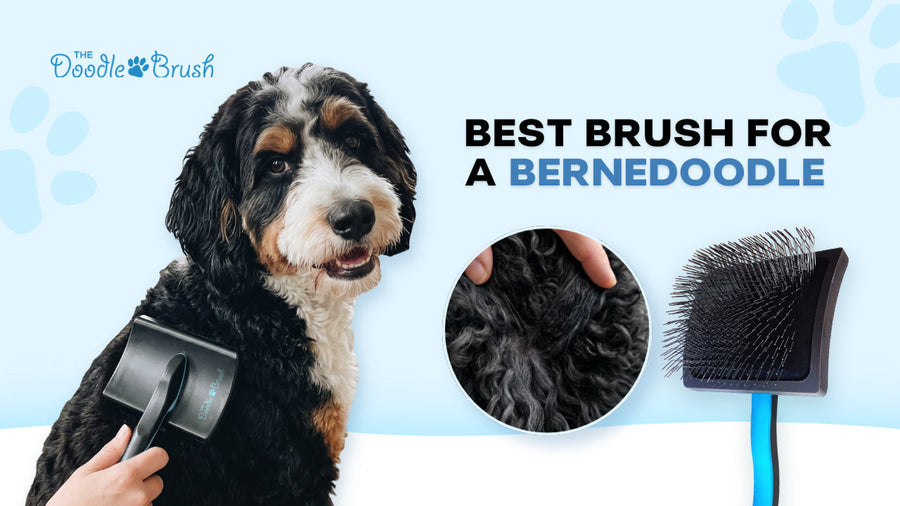

Bernedoodle owners tend to arrive at the same discovery around the six-month mark: the brush that worked on the puppy coat suddenly isn't getting anywhere near the skin. The dog looks brushed. The groomer says otherwise.
This article covers what a Bernedoodle coat actually is, why standard slickers fall short on it, and which brush genuinely works.
What is a Bernedoodle coat like?
Like every Poodle cross, there's no one Bernedoodle coat — it varies dog to dog. Some lean curly like the Poodle parent, some carry a soft wave, some sit straighter. What you can't do is guess a coat by breed or by size; two Bernedoodles can need noticeably different care.
That said, many Bernedoodle coats have one trait that matters enormously for brush choice: density and depth. The Bernese side often brings a thicker, fuller coat, and on a bigger frame there's simply more of it. Loose hair gets trapped deep inside that coat and twists into tangles close to the skin — and mats form everywhere on the body, just faster in the five high-risk zones: behind the ears, the collar line, the legs, the tail, and the armpits.
Do Bernedoodles shed?
Bernedoodles are typically low-shedding — but "low-shedding" is widely misunderstood.
Hair still comes loose; it just doesn't fall to the floor. It stays caught inside the coat, wrapped around live hair, and that trapped hair is the raw material of every mat your dog will ever have. The thicker the coat, the more hair it can quietly hold before you notice a problem.
So the low-shedding coat isn't a reason to brush less. It's the reason brushing is non-negotiable.
Why standard slickers fail a Bernedoodle coat
Three failures, and the first two apply to almost every slicker on a shop shelf:
1. Pins that aren't properly finished. Cheap slickers have pin tips that aren't rounded or polished, and those tips scratch the skin. One or two scratchy sessions and your Bernedoodle decides brushing is something to escape.
2. A rigid, fixed head. When a fixed head hits a tangle, it catches and snags, wrenching at the coat. This is a separate problem from the pins — you can have perfect pins on a rigid head and still lose your dog's trust at every knot.
3. Pins that are simply too short. This is the Bernedoodle-specific failure. On a deep, dense coat, standard-length pins glide across the top third of the coat and never reach the skin. You get a fluffy surface, an untouched undercoat, and a matted dog who was "brushed every day."
The best brush for a Bernedoodle
For denser, thicker Bernedoodle coats, we recommend the Extra Long Pin Slicker.
The extra-long pins are the point: they reach through the depth that defeats a standard slicker, working right down into the undercoat where trapped hair actually collects. The pins are super-rounded and highly polished, so what meets the skin is comfortable — which also makes this brush a strong choice for brush-sensitive dogs who've had bad experiences with scratchy tools.
If your Bernedoodle's coat runs shorter or finer, the Double Head Flexible Slicker may suit better — its flexible head absorbs resistance rather than catching on tangles, and is the gentler option in the system. When in doubt, check your dog's coat depth: if you can't easily see skin when you part the coat, go long.
How to brush a Bernedoodle
-
Line brush, always. Part the coat, brush from the skin outward, move up a line, repeat. On a coat this deep, surface strokes achieve nothing.
-
Prioritise the five zones. Behind the ears, collar line, legs, tail, armpits — friction and moisture make these the fastest-matting areas.
-
Short daily sessions. A big coat is maintained in five-minute sessions, not weekend marathons.
-
Comb check to finish. Run a finishing comb through as the final check — if it glides, the job's done; if it meets resistance, return to the brush there. The comb checks the work; it never does the detangling.
A tangle-free Bernedoodle also keeps its choices at the groomer: a coat in good condition gets clipped with a guard to the length you actually want, and you avoid unwanted shave-downs entirely.
One brush can't do 4 jobs
Deep body coat, intricate areas like armpits and behind the ears, everyday maintenance, and the final check — four different jobs, and one brush can't do 4 jobs. The Doodle Brush Grooming System pairs the Extra Long Pin Slicker with the right tools for the rest, built around Doodle coats from the start.
Build your Doodle Brush Grooming System →
Stay Connected with Us:
👉 Follow our Doodle Brush Facebook Page for expert grooming tips, tutorials, and updates.
👉 Join The Tangle-Free Doodle Club, our private Facebook group for Doodle parents — share grooming stories, get tips, and take part in giveaways!
Related Articles:
📓 What to look for in a slicker brush for Doodles
📓 The 3 stages of matting and how to fix each one
📓 Best brush for a Goldendoodle
Q&A |
What is the best slicker brush for a Bernedoodle?For denser, thicker Bernedoodle coats, an extra-long pin slicker — the longer pins reach through the coat's depth to the undercoat, which standard-length pins can't do. Do Bernedoodles shed?Bernedoodles are typically low-shedding. Loose hair stays trapped in the coat rather than falling out, which is why regular deep brushing is essential to prevent matting. What is a Bernedoodle coat like?It varies by dog — curly, wavy or straighter — but many Bernedoodle coats are notably dense and deep, which is what makes brush choice so important. How often should I brush a Bernedoodle?Daily short sessions work best, focusing on behind the ears, the collar line, legs, tail and armpits. |


