
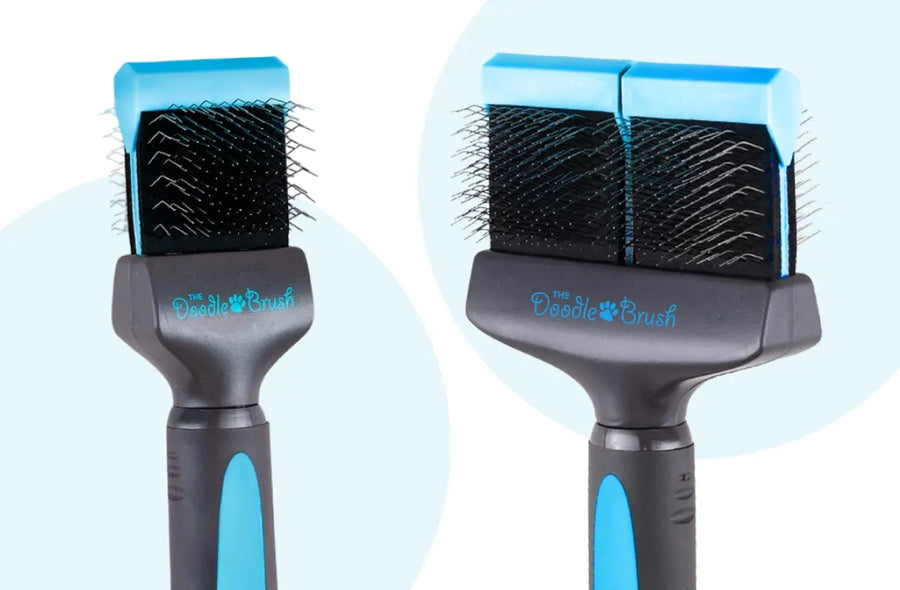

What's actually different between the Single Head Slicker Brush and the Double Head Slicker Brush? It's one of the questions Doodle owners ask us most — and at first glance, it's easy to see why. Both are built for Doodle coats. Both use the flexible head that absorbs resistance and reaches deeper into the undercoat, where tangles hide.
But they do different jobs — and knowing which brush suits which zone matters, because reaching for the wrong brush is a quiet reason home brushing doesn't prevent matting, even when you're being consistent. Here's what separates them, and when to use each.
Why Doodle coats change the brush conversation
A Doodle coat is curly and dense. Dead hair doesn't fall away the way it does on other breeds — it stays trapped in the curl and compresses down into the undercoat, close to the skin. That's where Doodle matting starts, before anything shows on the surface.
On top of that, a Doodle body curves. The shoulders, ribs, hips, collar line, and back of the legs all have contours a flat, rigid brush can't stay in contact with — meaning the most mat-prone zones often get the least contact.
The Single Head Flexible Slicker and the Double Head Flexible Slicker are both built around these two realities. They just solve different parts of the problem.
The Double Head Flexible Slicker — built for the main body
The Double Head is the main-body tool. It's designed for the wider, flatter areas of a Doodle's coat: the back, shoulders, sides, chest, and flanks.
The name describes the design. The brushing surface is split into two independently moving sections. As the brush passes across the body, each half stays in full contact through the curves of the ribcage, hip, and shoulder, rather than lifting off at the high points.
Here's the specific problem it solves. A fixed-head slicker placed across a Doodle's ribs makes solid contact in the centre and lifts off at the edges. That's the reason for the familiar feeling that you've brushed a whole area but the coat still feels dense when the Finishing Comb runs through it — the outer edges of every stroke never made full contact. The double head keeps contact across the full width.
The Double Head also uses longer pins than a typical standard slicker, reaching past the surface of the curl into the mid-layer of the coat. In the routine, it's the step one tool: the main body first, while your dog settles into the session on the easiest ground.
The Single Head Flexible Slicker — built for the tricky spots
The Single Head is the smaller, more precise tool. It's designed for the five high-risk matting zones on a Doodle:
-
Behind the ears
-
The collar line
-
The legs
-
The tail
-
The armpits
These zones share three things: they're small, they involve tight curves, and they experience friction. A wider slicker head can't work cleanly in any of them — it overshoots or has to be held at an awkward angle. This is why most mats found at the groomer are clustered in exactly these five places.
The Single Head has a narrow brushing surface, a flexible head that stays in contact in tight spots, and super-rounded, highly polished pin tips that mean no scratching. In the routine, it's the step two tool: the tricky spots after the main body, once your dog has settled — with the precision to work each zone properly.
Side-by-side: the key differences
Head size
-
Single Head: narrow — designed for the tight zones.
-
Double Head: wider — designed for broad main-body coverage.
Flexibility
-
Single Head: one flexible head.
-
Double Head: two independently flexing sections for full contact across curves.
Pins
-
Both: rigid pins with super-rounded, highly polished tips. Note: it's the head that flexes, not the pins — flexible pins would be a failure mode, not a feature.
-
The Double Head has longer pins to reach past the surface of the curl.
Where each one works best
-
Single Head: behind the ears, the collar line, the armpits, the legs, the tail.
-
Double Head: the main body — back, shoulders, sides, chest, flanks.
Position in the routine
-
Double Head: step one. Main body first.
-
Single Head: step two. Tricky spots, once your dog has settled.
What happens if you only use one
Using only the Single Head means the tricky spots are well-maintained, but main-body sessions take much longer than they should — you're doing broad-coverage work with a precision tool.
Using only the Double Head means the main body is well-maintained, but matting continues to form behind the ears, along the collar line, and in the armpits — because the wider head can't work cleanly in those zones.
Most Doodle coats are best served by using both, because they solve different parts of the same problem. The tricky spots need precision; the main body needs coverage. One brush can't do both without trade-offs.
Where each brush sits in the Doodle grooming order
The order matters as much as the brush choice. A well-built home routine looks like this:
-
Double Head Flexible Slicker on the main body — the back, sides, and chest — while your dog settles into the session.
-
Single Head Flexible Slicker on the tricky spots — behind the ears, the collar line, the legs, the tail, and the armpits.
-
Extra Long Pin Slicker for longer, thicker, or denser coats — the longer pins reach the deeper layers where mats start.
-
Finishing Comb as a check after brushing, through every zone. If it glides, you're done. If it catches, that's where to go back.
The difference, in one line
The Double Head Flexible Slicker is built for the main body. The Single Head Flexible Slicker is built for the tricky spots. Both use the same flexible head design. Both use the same rigid, super-rounded, highly polished pin tips. They sit in different steps of the same routine — which is why they work best together rather than as alternatives.
What matters more than the brushes themselves is understanding which zones on your Doodle's body need which tool — and using them in the order that makes the coat work with you instead of against you. 🐾
👉 Shop The Doodle Brush Grooming System
Stay Connected with Us:
👉 Follow our Doodle Brush Facebook Page for expert grooming tips, tutorials, and updates.
👉 Join The Tangle-Free Doodle Club, our private Facebook group for Doodle parents — share grooming stories, get tips, and take part in monthly giveaways!
Related Articles
📓What to Look for in a Slicker Brush for Doodles
📓What Does a Pin Brush Do for Dogs ?
📓The Complete Guide to Doodle Grooming Tools (And What You Actually Need)
Q&A |
Single vs double slicker — which is better?Neither. They're built for different zones. There isn't one single "best doodle dog brush" — most Doodle coats need both: the Double Head for coverage on the main body, the Single Head for precision in the five high-risk zones. Can I use just the Double Head and skip the Single Head?You can, but matting will almost certainly continue to form in the tricky spots — behind the ears, along the collar line, and in the armpits — because the Double Head can't work cleanly in those zones. Do the pins flex?No. The pins are rigid, with super-rounded, highly polished tips. It's the brush head that flexes. Rigid pins are what reach the coat reliably; a flexible head is what keeps the brush in contact with the body through the curves. Will these brushes scratch my Doodle?No — the super-rounded, highly polished pin tips mean no scratching against the skin. For brush-sensitive dogs, the flexible head design is also the gentlest way to brush a Doodle coat: the head absorbs resistance instead of dragging on tangles, so sessions feel closer to a massage. For denser coats, the Extra Long Pin Slicker adds reach — the longer pins clear more coat per stroke, so there's less brushing to get through. How often should I use each brush?Both are part of the same session, used in order — Double Head on the main body first, Single Head on the tricky spots second — at least three times a week, around five minutes each time. Little and often is what keeps the coat clear. |
The difference, in one line
The Double Head Flexible Slicker is built for the main body. The Single Head Flexible Slicker is built for the tricky spots. Both use the same flexible head design. Both use the same rigid, super-rounded, highly polished pin tips. They sit in different steps of the same routine — which is why they work best together rather than as alternatives.
What matters more than the brushes themselves is understanding which zones on your Doodle's body need which tool — and using them in the order that makes the coat work with you instead of against you. 🐾


