
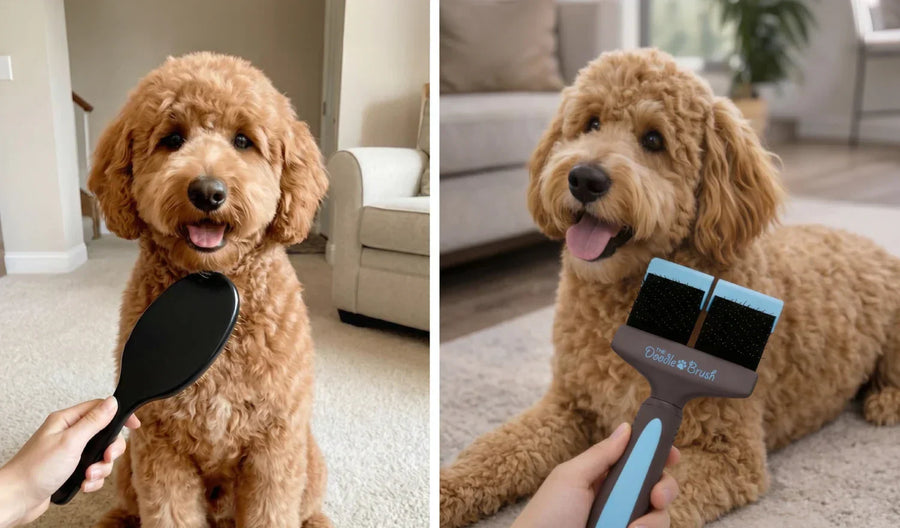

If you've ever stood in front of the pet shop brush wall and wondered what the difference is between a pin brush and a slicker brush — you're not alone. They look similar, they're often sold side by side, and most packaging doesn't do a great job of explaining when you'd use one over the other.
So here's the honest answer. Not both are wrong — but for a Doodle coat specifically, only one of them does the job properly. And we learned that the hard way, which is part of why we ended up building the Doodle Brush Grooming System.
What a pin brush is actually for
A pin brush has widely spaced, straight pins set into a flat or curved head, usually with small rounded tips. It looks like a human hairbrush, and in a lot of ways, it behaves like one.
Pin brushes are designed for finishing — smoothing the outer layer of the coat, giving it a polished look, removing surface debris. They're great for silky-coated breeds like Yorkies or Afghan Hounds where the coat lies flat and needs a gentle daily brush to stay neat.
What a pin brush isn't designed to do is work through tangles. The pins are too far apart and too straight to catch or separate trapped hair. Run a pin brush through a Doodle's coat and it feels lovely — it glides right over the top. The problem is it glides over everything, including the tangles and the dead hair that's starting to mat close to the skin. You feel like you've brushed your dog. The coat, underneath, hasn't been touched.
What a slicker brush is actually for
A slicker brush has short, fine, angled pins packed closely together on a flat or curved head. Those angled pins are designed to catch — to hook into loose hair and tangles and pull them out of the coat.
For shedding breeds with shorter coats, a standard slicker is usually enough. The dead hair is loose in the coat, the slicker catches it, and you're done.
For Doodles, a standard slicker is better than a pin brush — but it's still not the full answer. And this is where most owners get stuck.
Why neither is quite right for a Doodle coat on its own
Doodle coats are curly, dense, and low-shedding. Because they're low-shedding, dead hair doesn't fall away like it does on a Labrador or a Golden Retriever. It stays held in the curl, tangles with the living hair around it, and compresses close to the skin. Out of sight.
A pin brush skims the top. A standard slicker catches the surface tangles but usually doesn't reach deep enough. So you end up with owners who are brushing every day with one or both — and still having their groomer find mats close to the skin that they didn't know were there.
That was exactly our experience when we got our first Doodle. We had a pin brush. We had a slicker. We were brushing. And we were still getting the "there were some mats underneath" conversation at every appointment.
What we learned, and what we built
The issue wasn't how often we were brushing. It was that neither tool was designed for what a Doodle coat actually needs — which is a brush that can reach the dense layer close to the skin without snagging, pulling, or stressing the dog.
So we ended up designing the Doodle Brush Grooming System around that problem. It's not one brush — it's a small set of tools, each built for a specific part of the job:
→ The Single Head Flexible Slicker is for the tricky spots: armpits, collar, behind the ears, legs, and tail. The narrow, flexible head fits into tight areas without snagging or pulling.
→ The Double Head Flexible Slicker is for the main body. Wider contact, flexible head, glides through section by section.
→ The Extra Long Pin Slicker is for longer, thicker, denser coats. The longer pins reach deeper into the coat — closer to the skin, where mats quietly form. It's also the gentler option for brush-sensitive dogs, because the extra length means each pass glides rather than drags.
→ The Finishing Comb is the final check after brushing. If it glides, the coat is done. If it catches, it points straight to any tangle that was missed.
Each tool does one specific job. Together they cover every layer of a Doodle coat — which is what a pin brush on its own, or a standard slicker on its own, simply can't.
So: pin brush or slicker brush?
If you have a silky-coated breed that needs a daily surface tidy — a pin brush is probably all you need.
If you have a shedding breed with a shorter coat — a standard slicker will likely cover it.
If you have a Doodle — honestly, neither on its own is going to give you the result you want. You need a system built around how a Doodle coat actually behaves: one brush for the tricky spots, one for the main body, one that can reach the deeper layer on longer or thicker coats, and a comb to check your work at the end.
We built the Doodle Brush Grooming System because that's what our Doodle needed. Every brush we'd tried before it either missed the layer that mattered or made the session harder for both of us.
If you've been through the same cycle — a drawer full of brushes, none of them quite right, and mats still turning up at the groomer — this is what we'd have wanted someone to tell us three years ago.
👉 Learn more in our Doodle Grooming Guide
🎁 Explore our best-selling Doodle Brush tools
Stay Connected with Us:
👉 Follow our Doodle Brush Facebook Page for expert grooming tips, tutorials, and updates.
👉 Join The Tangle-Free Doodle Club, our private Facebook group for Doodle parents — share grooming stories, get tips, and take part in monthly giveaways!


