
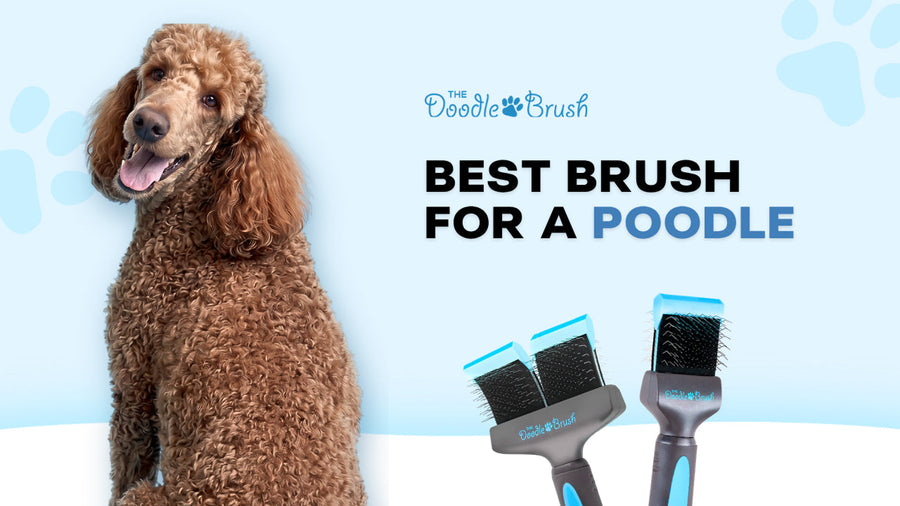

Every Doodle owner is, whether they know it or not, managing a Poodle coat with a twist. So it's only fair the parent breed gets its own answer — because Poodle owners face the original version of the same problem: a coat that never stops growing, never lets go of loose hair, and mats from the skin outward while looking perfectly fine on top.
Here's the brush that works, why, and how to use it.
What kind of coat does a Poodle have?
A Poodle coat is the purest form of the coat every Doodle inherited a share of: dense, tightly curled, and continuously growing. It was purpose-bred for a working water dog, and the same structure that made it brilliant in a lake makes it demanding in a living room.
The defining trait is what the coat does with loose hair. Poodles are typically low-shedding — but that hair doesn't vanish. It stays woven into the curls, twisting around live hair close to the skin until it forms tangles, then mats. Left unbrushed, a Poodle coat felts — quietly, invisibly, from the skin outward.
Mats form everywhere on the body, just faster in the five high-risk zones: behind the ears, along the collar line, the legs, the tail, and the armpits.
Do Poodles shed?
Very little — and that's exactly why they need more brushing than most breeds, not less. In a shedding breed, loose hair falls to the floor. In a Poodle, the curl catches it and holds it against the coat, where it becomes tangle material. "Low-shedding" describes your carpet, not your workload.
The best brush for a Poodle coat
The job description is specific: reach through dense, continuously growing curl to the skin, without a fight your Poodle will remember.
For Standard Poodles: the Double Head Flexible Slicker. The wider head covers a Standard's frame efficiently, and the two independently flexing sections keep full pin contact through the curves of the ribs, shoulders and hips — where a rigid, fixed head makes contact in the middle of the stroke and lifts off at the edges. The flexible head absorbs resistance when it meets a tangle instead of catching and dragging, which is what keeps a Poodle relaxed enough to be brushed properly, often. The pins are super-rounded and highly polished — run the brush firmly across your own inner forearm and it should feel like a firm massage, nothing more.
For Miniature and Toy Poodles: the Single Head Flexible Slicker. Same flexible head, smaller format — sized for a smaller frame and for the precision the five high-risk zones demand on any Poodle.
For dense adult coats kept long: the Extra Long Pin Slicker. Its longer pins reach through depth a standard slicker can't, clearing more coat per stroke — less brushing to get through on a full-coated Standard.
And always: the Finishing Comb. After brushing, run it through each section to the skin. If it glides, that section is genuinely clear. If it stops, there's still a tangle — go back with the slicker, then check again. The comb is a check, never a detangling tool.
How often should you brush a Poodle?
For a curly coat kept at any real length: daily is the goal, and every other day is the floor. Short sessions beat marathons — five minutes covering the five high-risk zones, with a full-body session a few times a week. Clipped-short coats can manage with less, but the zones still need their checks; mats don't respect a short haircut around the ears and armpits.
Puppies should start earlier than the coat strictly requires — the adult coat arrives between roughly 9 and 18 months in Poodles, and a puppy who already loves the brush sails through the change that mats most dogs.
What to avoid
The pet-shop standard slicker — rigid fixed head, short unpolished pins — is the brush most Poodle owners already tried before finding this page. On this coat it does two things badly: the fixed head catches and drags on every tangle, and short pins groom the top third of the coat while mats keep building at the skin. Bristle brushes and grooming gloves are surface tools; on a Poodle they polish the fluff and miss the problem entirely.
The bottom line
The best brush for a Poodle is the one built for the coat their curls gave every Doodle: a flexible head slicker matched to their size, backed by the Finishing Comb to prove each session actually reached the skin. Five minutes a day, five zones first, comb check to finish — and the coat that's famous for felting becomes one of the easiest keeps in the dog world.
🎁 Explore our best-selling Doodle Brush tools
Stay connected with Us:
👉 Follow our Doodle Brush Facebook Page for grooming tutorials and Doodle grooming tips.
👉 Join The Tangle-Free Doodle Club, our private Facebook group for Doodle parents — share grooming stories, get tips, and take part in giveaways!
Related Articles:
📓 Understanding Doodle coat types: straight, curly and wavy.
📓 What is a slicker brush used for
📓 How to brush a Doodle at home
Q&A |
What is the best brush for a Poodle?A flexible head slicker matched to size — the Double Head for Standards, the Single Head for Miniatures and Toys — with the Extra Long Pin Slicker for dense full-length coats, and a Finishing Comb to confirm each session reached the skin. Do Poodles shed?Very little. Loose hair stays trapped in the curls instead of falling out, which is why Poodles need frequent brushing — the trapped hair twists into tangles and mats close to the skin. How often should I brush my Poodle?Daily for curly coats kept at length, with every other day as the minimum. Short five-minute sessions covering behind the ears, the collar line, the legs, the tail and the armpits beat occasional marathons. Can I use a regular slicker brush on a Poodle?Rigid fixed-head slickers catch and drag on curly coats, and short pins miss the undercoat where mats form. A flexible head and adequate pin length are what make a slicker work on this coat. |


