
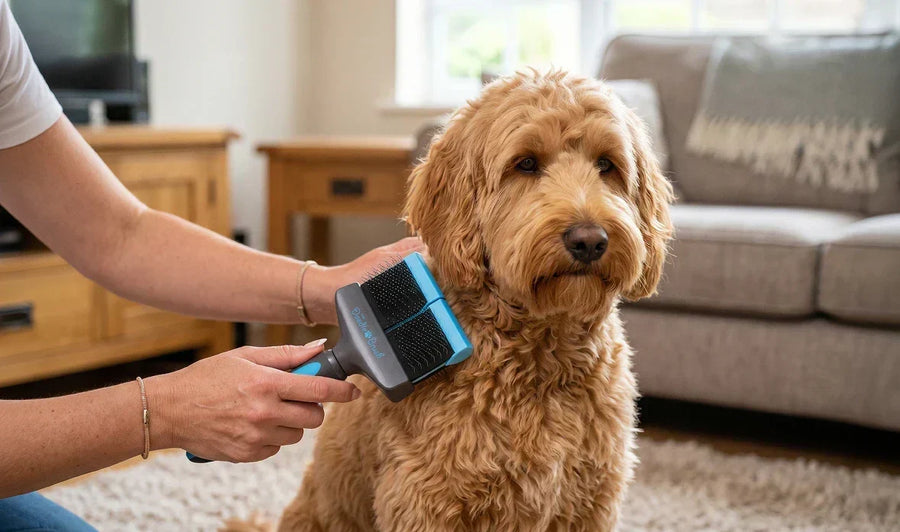

Labradoodles are known for their beautiful curly or wavy coats — but Labradoodle grooming done right is what keeps them tangle-free. Without the right tools and technique, brushing a Labradoodle can become a time-consuming and frustrating task. That's where The Doodle Brush comes in.
Whether you're dealing with light tangles or stubborn mats, this guide walks you through the best way to brush your Labradoodle — the tools, the technique, and the routine — for a happy, healthy, well-groomed pup.
Why Regular Brushing Is Essential for Labradoodles
Labradoodles have a coat that tangles easily: loose hairs don't fall away from the curl — they get trapped and wrap into knots down at the skin. Regular brushing helps to:
-
Prevent stubborn matting before it starts
-
Keep the undercoat tangle-free — not just the surface
-
Keep the coat clean and healthy
-
Distribute natural oils for a shiny, soft coat
-
Avoid costly de-matting charges at the groomer
Brushing your Labradoodle 3–4 times a week is ideal, and daily brushing is recommended for longer or curlier coats.
The Best Grooming Tools for Labradoodles
Not all brushes are created equal, and using the right one makes all the difference. The Doodle Brush Grooming System includes:
-
Double Head Flexible Slicker — ideal for efficient full-body brushing and everyday maintenance.
-
Single Head Flexible Slicker — perfect for precision work on the tricky spots: behind the ears, the collar line, the legs, the tail, and the armpits.
-
Extra Long Pin Slicker — best for reaching deep into dense, curly coats.
-
Finishing Comb — essential for checking your work and confirming no tangles are left behind.
All four share the same principle: a flexible head that absorbs resistance instead of dragging, and super-rounded, polished pins that mean no scratching — effective without being harsh on your pup's skin.
Step-by-Step Guide to Brushing Your Labradoodle
Step 1: Start with the Right Slicker Brush
For most Labradoodles, start with the Double Head Flexible Slicker on the main body — its wider head covers ground efficiently while your dog settles in. If your pup has a particularly thick, dense coat, add the Extra Long Pin Slicker: its longer pins reach the deeper layers a standard slicker struggles with.
Step 2: Work in Sections, From the Skin Out
Divide your Labradoodle's coat into sections so you brush every part thoroughly — starting from the paws and working your way up. In each section, part the coat so you can see the skin, brush outward from the skin in short strokes, then move up to the next line. This is what reaches the undercoat, where mats actually form — surface strokes alone leave the tangles underneath untouched. (For the full method, see our step-by-step guide to brushing a Doodle at home.)
Step 3: Switch to the Single Head for the Tricky Spots
Once the body is done, take the Single Head Flexible Slicker to the precision areas — behind the ears, along the collar line, the legs, the tail, and the armpits. These are the five zones where mats form fastest on almost every Labradoodle.
Step 4: Tackle Mats and Tangles Gently
If you encounter a tangle, use short strokes with your slicker, working from the edges of the tangle inward. For stubborn spots, hold the base of the hair near the skin with your free hand — this reduces the pulling sensation while you work the tangle out. A little detangling spray helps on resistant knots. Never force anything.
Step 5: Check with the Finishing Comb
After brushing, run the Finishing Comb through each section, all the way to the skin. If it glides smoothly without snagging, the coat is genuinely tangle-free. If it catches, that's your signal to go back to the slicker for that spot — the comb checks the work; it never does the detangling.
Tips for Making Brushing Easier
-
Brush regularly to prevent mats from forming — little and often beats marathon sessions.
-
Use detangling spray if needed to ease out tough knots.
-
Reward your dog with treats to make grooming a positive experience.
-
Choose a brush built for this coat — the flexible head is what keeps sessions comfortable enough that your Labradoodle stops dreading them.
Keep Your Labradoodle's Coat Healthy
Keeping your Labradoodle's coat tangle-free doesn't have to be a struggle. With The Doodle Brush Grooming System, you have the right tool for every part of the routine — coverage, precision, depth, and the final check.
👉 Explore The Doodle Brush Collection
Stay Connected with Us:
👉 Follow our Doodle Brush Facebook Page for expert grooming tips, tutorials, and updates.
👉 Join The Tangle-Free Doodle Club, our private Facebook group for Doodle parents — share grooming stories, get tips, and take part in monthly giveaways!
Related Article
📓How to brush a Goldendoodle
📓How to Brush Your Doodle at Home: A Complete Step-by-Step Guide
📓The 5 Zones That Mat First on Almost Every Doodle
Q&A |
How often should I brush my Labradoodle?Brush your Labradoodle 3–4 times a week, and daily if the coat is longer or curlier. Regular brushing prevents stubborn matting, keeps the coat clean, distributes natural oils for shine, and helps you avoid costly de-matting charges at the groomer. Which is the best brush for Labradoodle coats?Match the tool to the job. The Double Head Flexible Slicker handles everyday full-body brushing; the Single Head Flexible Slicker covers precision work in the tricky spots (behind the ears, collar line, legs, tail, armpits); and the Extra Long Pin Slicker reaches deep into dense, curly coats. Always finish with the Finishing Comb to confirm no tangles remain. All share the same flexible head and rounded, polished pins, so they're effective without being harsh on the skin. What's the best technique for brushing a Labradoodle to avoid missing tangles?Short answer: Work in sections from the paws upward so you cover every area, and brush from the skin out: part the coat to the skin, brush outward in short strokes, then move up to the next line. This is what reaches the undercoat where mats form — surface brushing alone leaves them behind. How should I handle mats and stubborn tangles safely?Use short strokes with your slicker, working from the edges of the tangle inward, and hold the hair at the base near the skin to reduce pulling. Apply a little detangling spray on resistant knots, and reward your dog with treats so grooming stays positive. Once the tangle clears, confirm with the Finishing Comb — the comb is only ever the check, never the detangling tool. If a mat sits tight against the skin, leave it for your groomer. How do I know I'm finished brushing?After slicker brushing, run the Finishing Comb through each section all the way to the skin. If it glides smoothly without snagging in every zone — including behind the ears, the collar line, and the armpits — the coat is genuinely tangle-free. Regular sessions with the right tools keep it that way. |


