
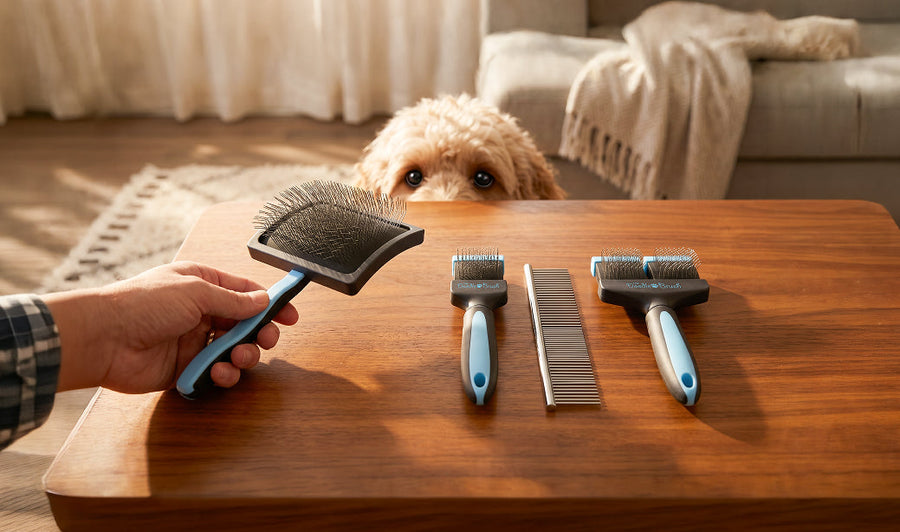

If you're a Doodle parent, you already know that grooming is a big part of life. Whether it's preventing mats, keeping that signature soft coat looking its best, or avoiding the dreaded shave-down, the right tools are what make the routine work. But with so many options out there, it can be overwhelming to know where to start.
Don't worry — we've got you covered. In this guide we'll break down the essential tools every Doodle parent needs, explain what each one does, and why they're designed specifically for Doodle coats. We'll also touch on how to pick the right tool for your routine. No more trial and error. Let's dive in.
Double Head Flexible Slicker — The Everyday All-Rounder
The double head flexible slicker is your whole-body workhorse. It covers more coat with every stroke, which makes daily maintenance quick and keeps your Doodle's coat tangle-free with minimal fuss. For most Doodles, this is the brush you'll reach for most often — and the one to start each session with.
What it does:
-
Covers more, faster: the wider double head clears more coat per stroke, so full-body brushing is efficient and far less of a chore.
-
Reaches deeper into the undercoat: it works down into the coat where tangles hide, clearing them before they compact into mats.
-
Better tolerated: the flexible head absorbs resistance instead of dragging, and the super-rounded, highly polished pins mean no scratching or irritation.
Where it's used:
Across the main body — back, chest, sides, and flanks — at the start of every session, while your Doodle settles in on the easiest ground.
👉 Pro Tip: Use the double head regularly to stay ahead of matting and reduce the need for expensive grooming appointments.
Single Head Flexible Slicker — The Precision Brush
The single head flexible slicker is your detail tool — built for the tricky spots and intricate areas where mats tend to start first. It's compact, gentle, and easy to control around the parts of your Doodle that need a careful hand.
What it does:
-
Detangles gently: the flexible head is better tolerated than a rigid brush — it absorbs resistance rather than dragging through the coat, so brushing feels gentle rather than something to dread.
-
Reaches where it should: worked in small, careful strokes, it lifts tangles before they have a chance to set.
-
Gentle on sensitive skin: the pins are super-rounded and highly polished, so there's no scratching or irritation, even on the most delicate areas.
Where it's used:
The face, ears, paws, and the five high-risk zones — behind the ears, the collar line, the legs, the tail, and the armpits — the hard-to-reach spots where mats form fastest and where you most need precision.
👉 Pro Tip: Keep this one within reach for daily spot-checks of the high-risk zones, so small tangles never get the chance to become mats.
Extra Long Pin Slicker — For Deep, Dense Coats
If your Doodle has a thick, dense coat, you know how challenging it can be to get all the way down to the undercoat. The Extra Long Pin Slicker is your step-up tool for these thicker, longer coats.
What it does:
-
Reaches into denser coats: the longer pins get further down into the undercoat where mats start — into the depth a standard slicker can't reach as easily on a thick coat.
-
More coat per stroke: because it clears more with each pass, there's less brushing to get through — shorter sessions, same result.
Where it's used:
Ideal for longer, thicker, denser coats that need extra reach. Use it on larger areas like the back and chest, or target the zones where you know mats form beneath the surface.
Finishing Comb — The Final Check
The finishing comb is the last tool in the routine, and its only job is to confirm the work is done.
What it does:
-
Checks for hidden tangles: after you've brushed, pass the comb through to catch anything the brush missed. If it stops or snags, that's your signal to go back to the brush for that spot — never drag the comb through a tangle.
-
Confirms the finish: when the comb moves through without catching, you know the coat is genuinely tangle-free.
-
Perfect for detail work: the finer teeth are ideal for a precision check around the face, paws and tail.
Where it's used:
Always the final step, after you've worked through the coat with a slicker. It's a check, not a detangling tool.
How These Tools Work Together as a System
Here's how the four come together in a routine:
-
Start with the double head flexible slicker for efficient whole-body brushing — the daily habit that prevents mats before they form.
-
Switch to the single head for the tricky spots — the face, ears, paws, and the five high-risk zones — where a smaller, more controllable brush earns its place.
-
For thick or dense coats, follow up with the Extra Long Pin Slicker to reach further into the undercoat and clear the deeper knots a standard slicker leaves behind.
-
Finish with the comb to catch any stray tangles and confirm that professional, tangle-free finish.
Used together, these Doodle grooming tools keep your Doodle tangle-free and help you avoid the unwanted shave-down at the groomer — because one brush can't do four jobs.
Final Thoughts: Get the Right Tools for a Healthy Coat
Investing in the right grooming tools is one of the best things you can do for your Doodle. Regular grooming keeps their coat looking its best and tangle-free — and it strengthens the bond between you and your furry friend along the way.
With The Doodle Brush Grooming System, you have everything you need to maintain a beautiful, healthy coat. Whether you're looking to prevent matting, avoid unwanted shave-downs, or simply keep your Doodle looking their best, there's a tool in the System that suits your routine.
👉 Shop The Doodle Brush Grooming System
Stay Connected with Us:
👉 Follow our Doodle Brush Facebook Page for expert grooming tips, tutorials, and updates.
👉 Join The Tangle-Free Doodle Club, our private Facebook group for Doodle parents — share grooming stories, get tips, and take part in monthly giveaways!
Related Articles
📓What to Look for in a Slicker Brush for Doodles
📓Slicker Brush vs. Finishing Comb: Which One Do You Actually Need?
📓Single Head vs Double Head Slicker Brush for Doodles: What's the Difference?
Q&A |
What tools do you need for a Doodle?Four tools cover the whole routine: a double head flexible slicker for the main body, a single head flexible slicker for the tricky spots, an Extra Long Pin Slicker for thicker or denser coats, and a finishing comb to confirm the coat is genuinely tangle-free. Together they handle coverage, precision, depth, and the final check. What's the difference between the single head and double head flexible slicker?The double head clears more coat per stroke and is built for efficient whole-body brushing. The single head is your precision tool, sized for the tricky spots where mats start — the face, ears, paws and collar line. Most Doodle parents use both: double head for everyday full-coat work, single head for the detail areas. Both share the same flexible head and the same super-rounded, polished pins, so both feel gentle on the skin. Do I need the Extra Long Pin Slicker, and when should I use it?Short answer: Choose the Extra Long Pin Slicker if your Doodle has a thick, dense coat that's hard to reach down to the undercoat. Its longer pins get deeper to loosen hidden knots and clear more coat per stroke — so there's less brushing to get through on larger areas like the back and chest. Use it as a step up from your flexible slicker when extra reach is needed. What does the finishing comb add if I've already brushed?Short answer: The finishing comb is your final check for a truly tangle-free coat. After brushing, it catches anything the brush missed and confirms the finish, with finer teeth for precise checks around the face, paws and tail. It's the last step that takes the coat from brushed to confirmed-clear — used as a check, never to work through a mat. How should I use these tools together in a routine?Start with the double head for the body, then the single head for the tricky spots. For thick or dense coats, follow with the Extra Long Pin Slicker to reach into the undercoat and clear the deeper knots. Finish with the comb to confirm any remaining tangles are gone. Used together, this system keeps coats tangle-free and reduces the chance of a shave-down at the groomer. Which flexible slicker should I start with?If you're buying one to begin with, start with the double head flexible slicker — it handles everyday whole-body brushing, which is where most of the routine happens. Add the single head for precision around the face, ears, paws and collar line — the zones where mats form first and where a smaller, more controllable brush really helps. |


