
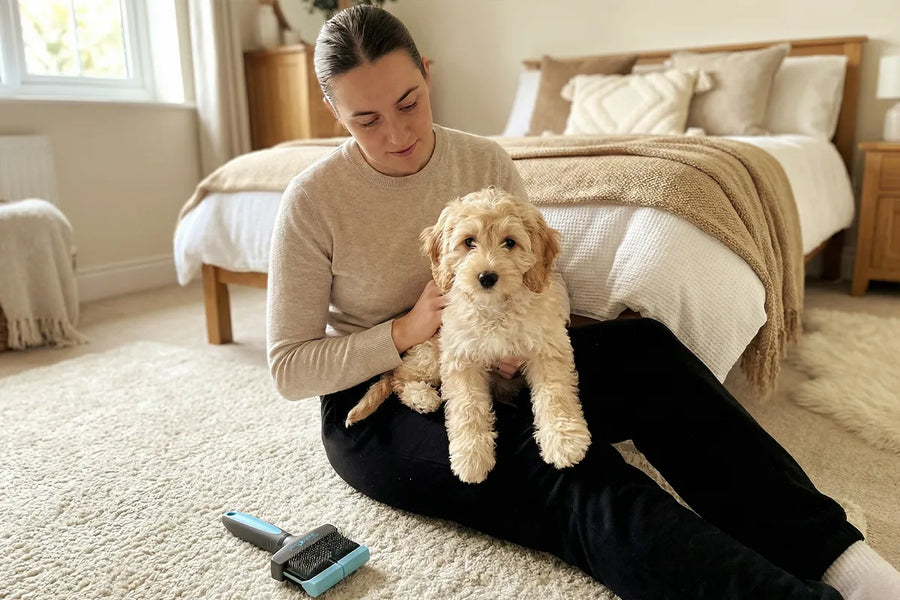

Congratulations on bringing home your new furry best friend! Whether you have just adopted a Goldendoodle, Labradoodle, Bernedoodle, or any of the wonderful poodle mixes out there, you are in for a lifetime of goofy smiles, unwavering loyalty, and unparalleled companionship.
But amidst all the puppy kisses and potty training, there is one major factor that catches almost every new doodle owner off guard: doodle puppy grooming.
That curly coat raises more questions than anything else in your first year together — when to start, how often, and with what.
If you were drawn to a Doodle by the promise of a "hypoallergenic, low-maintenance" dog, you're not alone. The truth is more nuanced: that beautiful teddy-bear fluff does need regular attention — but with the right technique and the right tools, it's genuinely manageable. This guide covers the science behind the coat, the tools to manage it, and the routines that keep your dog comfortable and mat-free.
Let's dive into the curly, wavy, and wonderfully complicated world of the Doodle coat.
The Reality of the Doodle Coat: Genetics at Play
To understand why your Doodle's coat behaves the way it does, look at the genetics. Cross a Poodle — a breed whose hair grows continuously and curls tightly — with a Golden Retriever or Labrador, and you get a highly unpredictable coat.
Purebred Poodles are often easier to maintain, because their coat is uniform: tight, dense curls all over. A Doodle's coat is different from dog to dog — some are curly, some wavy, and many carry a combination: the soft, dense undercoat of their non-Poodle parent mixed with the curling, continuous-growth topcoat of their Poodle parent — two coat types that were never meant to coexist.
Here's what happens inside that combination. Loose and dead hairs don't fall away from a curly coat. They get trapped in the undercoat, wrap around the attached hairs, and form tiny knots that quickly snowball into mats. And because it all happens down at the skin, you can't see it from the surface — which is why so many well-brushed Doodles still end up matted. It was never a lack of effort. It's the coat.
Many Doodles also have sensitive skin. When dead hair, dirt, and dander sit trapped against the skin, airflow is restricted — which can lead to hot spots, irritation, and infections. Regular brushing that reaches the skin isn't cosmetic; it's health care.
Surviving the Puppy Coat to Adult Coat Transition
When you first bring your Doodle puppy home, their coat will be soft, wispy, and surprisingly easy to manage. Enjoy this honeymoon phase — because a big change is on the horizon.
The coat change is the single most important thing to prepare for. Usually somewhere between 6 and 12 months of age, the soft puppy coat gives way to the denser, coarser adult coat.
This transition is notoriously the hardest period for any Doodle owner. The loosening puppy hair gets instantly trapped by the incoming adult curls, and the result is rapid, intense matting. You could brush your dog perfectly in the morning and find new mats forming by the evening. If that happens to you: it's not you. It's the transition.
Tips for surviving the transition:
-
Brush daily, without exception. Short daily sessions are the single most effective thing you can do during the coat change — this is when mats form fastest.
-
Consider a shorter trim. Many owners opt for a shorter "puppy cut" during these months to make the coat easier to manage while the change completes.
-
Be patient. The transition typically lasts a few months. Once the adult coat fully sets in, the overnight matting subsides — and your normal routine takes over.
The Ultimate Doodle Puppy Grooming Guide: Tools and Techniques
Building a grooming routine at home is non-negotiable. It keeps mats from ever taking hold, it saves money at the salon, and — just as importantly — it teaches your puppy that being handled is safe and even enjoyable. Those early positive sessions pay off for the rest of their life.
The Tools That Suit a Doodle Coat
A generic brush from the supermarket wasn't designed for this coat — and it's the reason so many owners brush regularly and still find mats. Two things matter most for curly and wavy coats: a flexible head, and enough pin length to reach the undercoat.
-
Single-Head Flexible Slicker — the ideal starting brush for a puppy. The smaller head gives you control on a small, wriggly body, and the flexible head absorbs resistance instead of dragging on tangles — so brushing feels closer to a massage than a chore. That comfort is what builds a puppy who tolerates (and eventually enjoys) grooming.
-
Double-Head Flexible Slicker — as your Doodle grows, the wider head covers the back, sides, and chest faster on medium and large breeds (Labradoodles, Goldendoodles, standard Bernedoodles).
-
Extra-Long Pin Slicker — for denser or tightly curled adult coats. The longer pins reach deeper into thick coats, into the layers where mats most commonly start. Not every Doodle needs it — a wavy coat may never call for it, while a curly coat of the same size almost certainly will.
-
Finishing Comb — the final glide test. A firm metal comb used after brushing to confirm the coat is genuinely tangle-free. If it snags, there's still a tangle. Only when it moves freely is the session truly done.
Also helpful:
-
Detangling spray — a light mist on a dry or resistant coat makes brushing noticeably easier and reduces the pulling sensation for your puppy.
-
High-value treats — essential while your puppy is still building positive associations with brushing.
-
Blunt-nosed grooming shears — for safely trimming hair around the eyes, paws, and sanitary areas.
Note that the brush and the comb aren't interchangeable — they're a two-step system. The slicker works through the coat; the comb checks it. Never use the comb to work on a tangled coat.
Mastering the Line Brushing Technique
If you remember only one thing from this guide, make it this: learn to line brush.
Surface brushing — passing the brush over the top of the coat — is what most owners were taught, because nobody told them mats form at the skin, not on the surface. It makes the coat look tidy while leaving the hair closest to the skin tangled.
Line brushing means brushing from the skin out, in layers, using the Part → Brush → Move Up method:
-
Settle your puppy comfortably — lying on their side works well. A light mist of detangling spray helps if the coat is dry or resistant.
-
Part the coat with your free hand so you can see a line of skin.
-
Brush outward from the skin in short, controlled strokes, working through that layer.
-
Move up — shift your parting hand up a fraction, revealing the next line of skin, and repeat.
Start at the paws and work up the legs, then the body, the tail, and finally the head and ears. When every section is done, run the Finishing Comb through the coat in the same sequence. If it glides freely everywhere, you're genuinely finished. If it snags, go back to that spot with the slicker.
Pay special attention to the five zones where mats form fastest on almost every Doodle: behind the ears, the collar line, the legs, the tail, and the armpits. Mats can form anywhere — they just form faster here.
Establishing Daily Maintenance
What does daily maintenance for non-shedding poodle mixes actually look like? It requires consistency.
-
Wavy coats: brush at least 3 times a week.
-
Curly, dense coats: 4–5 times a week, ideally daily.
-
During the coat transition: daily, without exception.
Short, frequent sessions always beat long, infrequent ones. Five to ten minutes several times a week prevents mats far better than one marathon session — and it's far less stressful for a puppy still learning to sit through grooming.
After walks: always check for debris. Doodle coats act like Velcro for burrs, twigs, and leaves — remove them straight away, before they twist into the coat.
Bathing and Drying at Home: A Science of Its Own
Bathing a Doodle isn't as simple as lathering them up and letting them dry in the sun. Air-drying a curly coat is a guaranteed recipe for tight, stubborn mats: as wet hair dries, it shrinks and curls back on itself, tightening any existing knots.
The Power of the Blowout
If you plan to bathe your dog at home regularly, a high-velocity (HV) dryer is worth looking into. It's a powerful grooming tool that blasts the water off the skin, and it earns its place three ways:
-
Straightens the coat — the force of the air blows the curl out of the hair, leaving it fluffy and far easier to brush.
-
Protects the skin — a dense coat left damp can develop yeast and fungal problems. An HV dryer gets the dog dry down to the skin.
-
Loosens tangles — the airflow helps push minor tangles apart before you even pick up a brush.
Bathing best practices: always brush your dog completely before the bath. Water acts like superglue on mats — wash a matted dog and those mats solidify into tight felt. Use a quality moisturising dog shampoo and follow with a hydrating conditioner.
Tackling the Sensitive Areas: Ears, Paws, and Eyes
Doodles have some specific needs from their mixed heritage, and staying on top of them saves vet bills later.
Ear Care
Dealing with doodle ear canal hair is an unpleasant but vital reality. Because Poodles grow hair continuously all over their bodies, many Doodles grow hair inside their ear canals too. That hair traps moisture, wax, and bacteria, which can lead to recurring ear infections.
Ask your veterinarian or groomer to show you how to manage it for your dog. Some dogs do best with the canal hair gently removed using ear powder for grip; others have sensitive ear canals that react badly to plucking, and the hair should be carefully trimmed short instead. Alongside hair management, use a vet-approved ear cleaner weekly to flush out debris.
Paws and Sanitary Areas
The hair between your Doodle's paw pads grows continuously. Left unchecked, it mats with mud and snow, making walking uncomfortable and floors slippery. Use blunt-nosed shears to keep the pads trimmed flush. Keep the sanitary areas trimmed short too, so nothing gets caught in the coat between grooming appointments.
Professional Grooming: What to Expect and When to Go
Even the most dedicated owner equipped with a top-tier grooming kit will need the help of a professional. Groomers have the expertise to properly trim, shape, and balance your dog’s coat, handle nail grinding safely, and express anal glands if necessary.
Scheduling and Frequency
The frequency of professional doodle haircuts depends entirely on how long you want to keep your dog's coat and how much brushing you are willing to do at home.
-
Long Coat (Teddy Bear Look): Requires professional grooming every 4 weeks, plus daily line brushing at home.
-
Medium Coat: Requires professional grooming every 6 weeks, plus brushing every other day.
-
Short Coat (Kennel Cut): Requires professional grooming every 8-10 weeks, with minimal brushing at home.
Certain generations require even more frequent care. For example, the grooming requirements for F1b goldendoodles (which are 75% Poodle and 25% Golden Retriever) are exceptionally high. Their coats are almost entirely curly, mimicking the purebred poodle, which means they mat incredibly fast and require rigid, professional maintenance schedules.
One heads-up on cost: expect Doodle grooming to cost more than most breeds, and for good reason. A full bath, blowout, brush-out, and haircut on a large Doodle can take a groomer three to four hours of skilled physical work, and Doodle coats wear down blades and shears faster than almost any other coat type. Your home routine is what keeps those appointments shorter and cheaper.
The Nightmare Scenario: Pelting
It is crucial to discuss the severe consequences of neglected grooming. When minor tangles are ignored, they merge together. Over time, these mats weave into a solid, impenetrable sheet of felted fur that tightly grips the dog’s body like a cast.
You must learn to recognize the signs of pelted dog fur. If your dog’s fur feels like a hard carpet beneath the soft top layer, if you cannot see their skin when you part the hair, or if the dog flinches when you touch certain areas, they are likely pelted. Pelting pulls tightly on the skin with every step the dog takes, cutting off blood circulation and hiding dangerous skin infections, parasites, and sores.
If a groomer tells you your dog is pelted and must be shaved down, do not argue with them. It is impossible (and incredibly inhumane) to brush out a pelted coat. A #10 blade shave-down is the only safe, painless medical reset for the dog. The hair will grow back, and you can start fresh with better brushing habits!
Conclusion: Embracing the Doodle Lifestyle
Welcoming a doodle into your home is a commitment of time, finances, and love. Yes, the coat is demanding. Yes, you will likely spend more time brushing your dog than styling your own hair. But the reward is a spectacularly affectionate, intelligent, and joyful companion who turns heads wherever they go.
By arming yourself with the right knowledge, investing in quality tools, and establishing a positive daily routine, you are setting yourself up for success. You now have everything you need to thoroughly rock a doodle parents guide approach to grooming. Embrace the curls, trust the process, and enjoy every beautiful, fluffy moment with your new best friend.
🎁 Explore our best-selling Doodle Brush tools
Stay Connected with Us:
👉 Follow our Doodle Brush Facebook Page for expert grooming tips, tutorials, and updates.
👉 Join The Tangle-Free Doodle Club, our private Facebook group for Doodle parents — share grooming stories, get tips, and take part in giveaways!
Related Articles:
📓 Understanding Doodle Coat Types: Straight, Curly, and Wavy
📓How to Get a Doodle Puppy Used to Being Brushed
📓The 5 Zones That Mat Fastest on Almost Every Doodle
Q&A |
Question: When should I start grooming a Doodle puppy?From day one — but start with handling, not marathon sessions. Short, positive brushing sessions (a few minutes, with treats) teach your puppy that grooming is safe long before the adult coat arrives. By the time the coat change starts at 6–12 months, brushing should already feel routine to them. Question: How often should I brush a Doodle puppy?At least 3 times a week for wavy coats and 4–5 times a week (ideally daily) for curly, dense coats. During the coat transition — roughly 6 to 12 months of age — brush daily without exception, as this is when mats form fastest. Short, frequent sessions beat long, infrequent ones every time. Question: What is the Doodle coat change, and why does it cause matting?Between about 6 and 12 months, the soft puppy coat gives way to the denser adult coat. The loosening puppy hair gets trapped by the incoming adult curls and wraps into knots — which is why mats can appear overnight even on a well-brushed puppy. Daily line brushing through this phase is the answer. Question: What tools do I need for Doodle puppy grooming?A flexible head slicker brush (the Single-Head suits a puppy's small body; the Double-Head covers larger bodies as they grow), a Finishing Comb to confirm the coat is truly tangle-free after brushing, plus detangling spray, treats, and blunt-nosed shears for the eyes, paws, and sanitary areas. For dense or tightly curled adult coats, an Extra-Long Pin Slicker reaches the deeper layers. Question: Do Doodles still need a professional groomer?Yes — for trimming, shaping, and nails. How often depends on coat length: roughly every 4 weeks for a long teddy-bear coat, every 6 weeks for a medium coat, and every 8–10 weeks for a short coat. Your home brushing routine between grooming appointments is what keeps those visits smooth and keeps the coat from ever reaching a shave-down. |


