
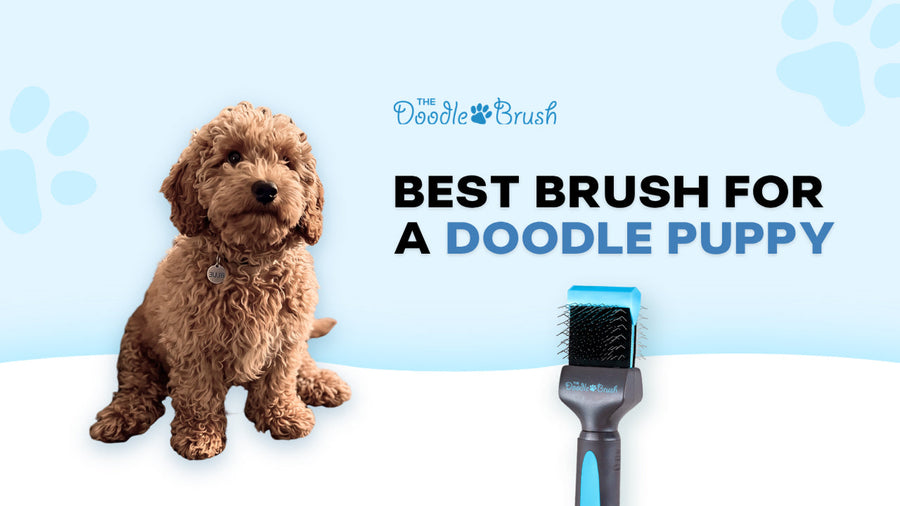

The brush you choose for your puppy matters more than any brush you'll ever buy them — not because the puppy coat is hard to brush, but because this is the brush that decides how your dog feels about brushing for the rest of their life. Get it right and you raise a Doodle who queues up for grooming. Get it wrong and you spend the adult years undoing it.
Here's what a puppy coat actually needs, when to start, and the grooming brush for a puppy that builds the right habit from day one.
What is a Doodle puppy coat like?
Deceptively easy. Puppy coats are soft, wispy, single-layered and almost tangle-proof — which is why so many owners conclude the brush can wait. It can't, for two reasons.
First, the coat change is coming. Somewhere between 6 and 12 months, the soft puppy coat gives way to the denser adult coat — and the loosening puppy hair gets instantly trapped by the incoming adult curl. It's the fastest-matting phase of a Doodle's whole life, and it arrives on a schedule that doesn't care whether your puppy has learned to sit through brushing yet.
Second — and more important — brushing tolerance is learned, not natural. A puppy brushed gently for two minutes a day from their first week home treats the brush as furniture by the time the coat change hits. A puppy who meets the brush for the first time at eight months, mid-coat-change, with tangles already forming, meets it under the worst possible circumstances.
The puppy months are the free training window. The coat barely needs the brush; the dog absolutely does.
When should you start brushing a puppy?
From the first settled week at home — so typically from about 8 to 10 weeks old. Not because the coat needs it, but because the habit does. Sessions at this age are 1–2 minutes, gentle to the point of barely brushing, and always end with something good. (The full step-by-step habituation method is in our guide to getting a Doodle puppy used to being brushed — this article's job is the tool.)
The best grooming brush for a puppy
A puppy brush has one job above all others: it must never give the puppy a reason to remember it badly. That sets three requirements.
Gentle by design. The Single Head Flexible Slicker is the puppy starter brush in our System for exactly this reason: the flexible head absorbs resistance instead of catching and dragging, so even when the brush meets a small tangle, the puppy feels give, not a yank. One bad pull during the impressionable weeks can take months to undo — the flexible head is what makes that pull mechanically unlikely.
Sized to the dog. A puppy is small; the brush should be too. The Single Head's smaller format works cleanly around a small face, small legs, and the five zones that will matter for life — behind the ears, along the collar line, the legs, the tail, and the armpits. Brushing those zones gently from puppyhood does double duty: it keeps them tangle-free and it teaches the puppy that having their ears lifted and paws handled is normal, which your groomer and your vet will thank you for.
Kind to the skin. Puppy skin is thinner and more sensitive than adult skin. The super-rounded, highly polished pins are the non-negotiable here — run the brush firmly across your own inner forearm; it should feel like a firm massage. If a brush feels scratchy on you, it's disqualified for a puppy, full stop.
Add the Finishing Comb from the start, used lightly — not because the puppy coat hides many tangles yet, but because "brush, then comb check" is the routine you want automatic before the coat change makes it essential.
As the adult coat arrives, the System grows with the dog: the Double Head Flexible Slicker takes over the body work on medium and large Doodles, and dense adult coats add the Extra Long Pin Slicker for depth. The Single Head never retires — it keeps the tricky spots for life.
How often should you brush a puppy?
Daily — but tiny. One to two minutes, at the same calm moment each day, ending before the puppy wants it to. Frequency builds the habit; brevity protects it. Through the coat change, the daily habit you've already built simply gets a little longer, and the phase that overwhelms unprepared owners passes as routine.
What to avoid
Anything rigid, anything scratchy, anything oversized. A fixed-head slicker that catches on the first real tangle of the coat change can undo six months of habit-building in one session. And avoid the temptation to skip brushing "until the coat needs it" — by then, you're introducing the brush and fighting tangles at the same time, to a dog who never agreed to either.
The bottom line
The best grooming brush for a puppy is the one that guarantees their first hundred sessions feel good: the Single Head Flexible Slicker, gentle by mechanism, sized to the dog, with pins that pass the forearm test — plus a Finishing Comb to make the lifelong routine automatic before it's ever needed. Start in week one, keep it tiny, and the coat change becomes a footnote instead of a crisis.
Build your Doodle Brush Grooming System →
Stay Connected with Us:
👉 Follow our Doodle Brush Facebook Page for expert grooming tips, tutorials, and updates.
👉 Join The Tangle-Free Doodle Club, our private Facebook group for Doodle parents — share grooming stories, get tips, and take part in giveaways!
Related Articles:
📓 How to get a Doodle puppy used to being brushed
📓 New Doodle parents starter guide
📓 The 5 zones that mat fastest on almost every Doodle
Q&A |
What is the best grooming brush for a puppy?A small, flexible head slicker with super-rounded polished pins — gentle enough that the puppy never has a bad session. For Doodle puppies, the Single Head Flexible Slicker is the starter brush, paired early with a Finishing Comb to build the brush-then-check routine. When should I start brushing my Doodle puppy?From the first settled week home, around 8–10 weeks old — one to two gentle minutes a day. The puppy coat barely needs it; the habit absolutely does, because the fast-matting coat change arrives at 6–12 months. How often should I brush a puppy?Daily, briefly. Short daily sessions build tolerance without testing patience, and the routine simply extends when the adult coat arrives. Do puppies need a different brush from adult dogs?The requirements are stricter, not different: smaller head, flexible head, polished pins. The same Single Head Flexible Slicker then keeps the precision work — ears, collar line, legs, tail, armpits — for life as body-coverage tools are added. |


