
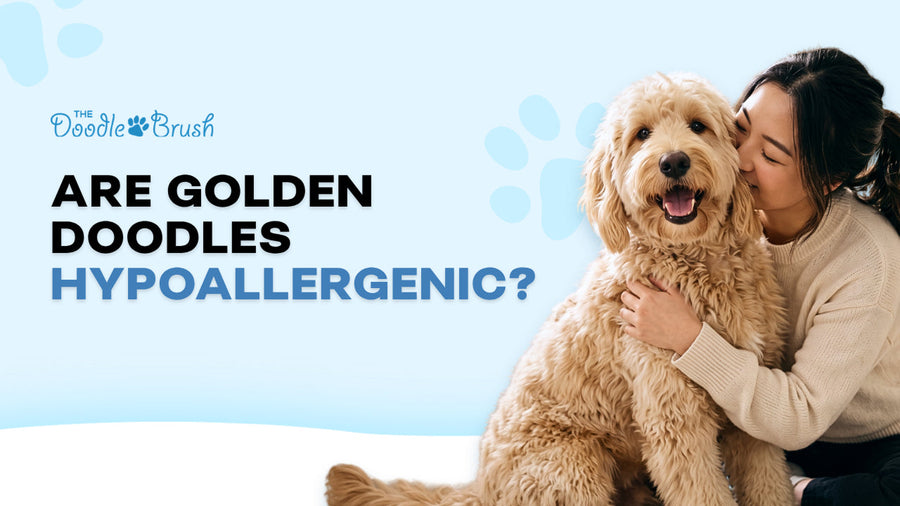

We breed Goldendoodles, which means we get asked this question more than any other — usually by someone who's fallen for a puppy photo and needs the answer to be yes. So here it is, straight, the way we give it in person:
No dog is truly hypoallergenic — including a Goldendoodle. But many Goldendoodles are easier to live with for allergy-prone households than most breeds, and there are real reasons why. Whether that's enough depends on your allergy, your dog, and how the coat is managed. Let's take those one at a time.
What "hypoallergenic" actually means
The word suggests "won't trigger allergies." What it can honestly mean is "less likely to." Dog allergies aren't caused by hair itself — they're triggered by proteins found in a dog's dander (shed skin flakes), saliva and urine. Every dog produces those proteins. There is no breed, cross or coat type that doesn't.
What varies is how much of that allergen ends up spread around your home — and that's where coat type genuinely matters.
Why Goldendoodles are often easier for allergy sufferers
Goldendoodles inherit some share of the Poodle's curly, continuously growing coat, and most are typically low-shedding. Loose hair — and the dander riding on it — doesn't fall to the floor and drift around the house the way it does off a shedding breed. It stays trapped in the coat until brushing or bathing removes it.
For many allergy-prone households, that containment is the difference between constant low-level exposure and manageable exposure. It's a real effect. It's just not the same as "allergen-free" — the proteins are still there, on the dog, waiting in the coat.
There's an irony worth knowing before you commit: the very trait that helps your allergies is the trait that creates the grooming workload. Trapped hair doesn't just hold dander — it twists into tangles and then mats, from the skin outward. A low-shedding coat is a high-brushing coat. The two come as a package.
Does generation matter? (F1 vs F1B and the rest)
Somewhat — as a tendency, never as guarantee. An F1 Goldendoodle (Golden Retriever × Poodle) can land anywhere on the coat spectrum, including a straighter coat closer to the Retriever parent, which releases more loose hair around the home. An F1B (an F1 crossed back to a Poodle) carries more Poodle genetics and tends toward the curlier, lower-shedding end.
But coats vary dog to dog, even within one litter — you cannot order a coat type by generation the way you'd order a size. Any breeder who guarantees a hypoallergenic puppy is telling you what you want to hear, not how genetics works. What an honest breeder can tell you is which way a litter leans, and what the parents' coats are like.
The only real test
If someone in your household has a significant dog allergy, there's one step worth more than everything else on this page: spend real time with the actual dog before committing — ideally in an enclosed space, more than once. Reactions are individual on both sides: to a specific person, to a specific dog. Some allergy sufferers are fine with one Goldendoodle and react to its littermate.
For anything beyond mild allergies, it's worth talking to your GP or an allergist before bringing any dog home. That's not us hedging — it's what we tell every allergy-prone family who enquires about a litter, because a rehomed dog is the outcome everyone's trying to avoid.
Living with a Goldendoodle when allergies are in the house
If you do go ahead, coat management is allergen management. The allergens sit in the coat; the routine is how they leave the house on your terms:
-
Brush regularly — outdoors if you can. Brushing lifts the trapped hair and dander out of the coat. Done outside (or by the least-allergic person), it removes allergen from circulation instead of releasing it into the living room. A flexible head slicker that reaches the undercoat does this properly; surface brushing just tidies the top. Our guide to the best brush for a Goldendoodle covers the tool, and the how-to guide covers the technique.
-
Bathe on a sensible schedule. Bathing rinses dander from the coat. Use a dog-specific shampoo and dry thoroughly — a damp Doodle coat tangles fast.
-
Manage the environment. Wash bedding regularly, keep the bedroom dog-free if reactions are meaningful, and let a HEPA filter handle what airborne dander there is.
-
Keep up the grooming appointments. A professionally maintained coat holds less debris and less loose hair between visits.
None of this cures an allergy. Together, it's often the difference between a household that works and one that doesn't.
The bottom line
Are Goldendoodles hypoallergenic? Not truly — no dog is. Are they one of the better choices for many allergy-prone households? Genuinely, yes: the low-shedding coat keeps hair and dander contained rather than airborne. The honest deal is that the containment only works if the coat is maintained — and that the only test that matters is time spent with the actual dog, before the papers are signed.
If the answer for your household turns out to be yes, start with our Doodle puppy grooming starter guide — because the coat that helps your allergies is about to become the most demanding thing about an otherwise easy dog.
🎁 Explore our best-selling Doodle Brush tools
Stay connected with Us:
👉 Follow our Doodle Brush Facebook Page for grooming tutorials and Doodle grooming tips.
👉 Join The Tangle-Free Doodle Club, our private Facebook group for Doodle parents — share grooming stories, get tips, and take part in giveaways!
Related Articles:
📓 New Doodle parents starter guide
Q&A |
Are Goldendoodles hypoallergenic?No dog is truly hypoallergenic — allergies are triggered by proteins in dander and saliva, which every dog produces. Goldendoodles are typically low-shedding, so hair and dander stay contained in the coat rather than spreading around the home, which makes many of them easier for allergy-prone households. Do Goldendoodles shed?Most shed very little — loose hair stays trapped in the coat instead of falling out. Straighter-coated Goldendoodles (more common in F1s) release more loose hair around the home. The trapped hair is why regular brushing is essential: it twists into tangles and mats close to the skin. Are F1B Goldendoodles better for allergies?They tend toward curlier, lower-shedding coats because of the extra Poodle genetics — but it's a tendency, not a guarantee. Coats vary within a single litter, and no breeder can promise an allergy-safe puppy. How can I reduce allergens from a Goldendoodle?Brush regularly with a slicker that reaches the undercoat (outdoors if possible), bathe on a sensible schedule with dog-specific shampoo, wash bedding often, and keep regular grooming appointments. For significant allergies, spend time with the specific dog before committing and speak to a doctor or allergist first. |


